
All deployed AI today is narrow AI, AGI hasn't been achieved, and ASI is still speculative. That matters because the central question for knowledge workers isn't when science fiction arrives, it's what today's tools can already do inside your actual workflow.
If you keep the labels straight, you'll make better calls about which systems to trust, where human review still matters, and which skills are worth sharpening now. If you blur them together, you end up buying hype instead of capability.
Table of Contents
- Why the AI vs AGI vs ASI Distinction Matters Right Now
- Defining AI, AGI, and ASI in Plain Language
- Capability Differences Across the Three Tiers
- Real-World Milestones and Where the Real Boundary Sits
- Timelines, Probabilities, and How to Read the Forecasts
- Risks, Ethics, and Governance Across the Three Tiers
- A Knowledge Worker's Playbook for the AI to AGI Window
- Frequently Asked Questions About AI vs AGI vs ASI
Why the AI vs AGI vs ASI Distinction Matters Right Now
Ignore the hype ladder. The useful way to read AI vs AGI vs ASI is as a workflow lens, because that tells you what changes for daily work today. Current systems already help with drafting, summarizing, coding support, and image work, but they are still narrow AI, meaning they handle specific tasks well and break outside their lane.
That distinction matters because teams keep using the wrong mental model. If you treat a chatbot like it is already close to AGI, you will expect human-level reasoning, durable memory, and broad transfer across new problems. It will not deliver that, and that mismatch is where bad planning starts.
Practical rule: judge a tool by whether it shortens your actual workflow, not by whether a vendor says it is “close to AGI.”
A lot of the confusion comes from headlines that treat the terms as if they are interchangeable. They are not. A useful overview like the Prompt Builder on AGI helps sort out the terminology, but the key takeaway for any team is simple, narrow AI is deployable now, AGI is not yet here, and ASI is still hypothetical.
The operational question matters more than the philosophy. Can the system help a team move faster without adding rework? Can it switch contexts safely, or does a human still need to steer it? That is why the labels now appear in board decks and product launches.
A strong demo can still be misleading. Learn more from ELECTE's Newsletter on AI hype is useful if you want a cleaner view of how progress can look general without being general. Teams that miss that difference often mistake surface fluency for a new category of intelligence.
That confusion leads to weak strategy. If you assume AGI is already here, you will underinvest in workflow design, verification, and policy. If you dismiss everything outside science fiction, you will miss the productivity gains already on the table, including systems built on natural language processing that handle everyday text work well enough to matter.
Defining AI, AGI, and ASI in Plain Language
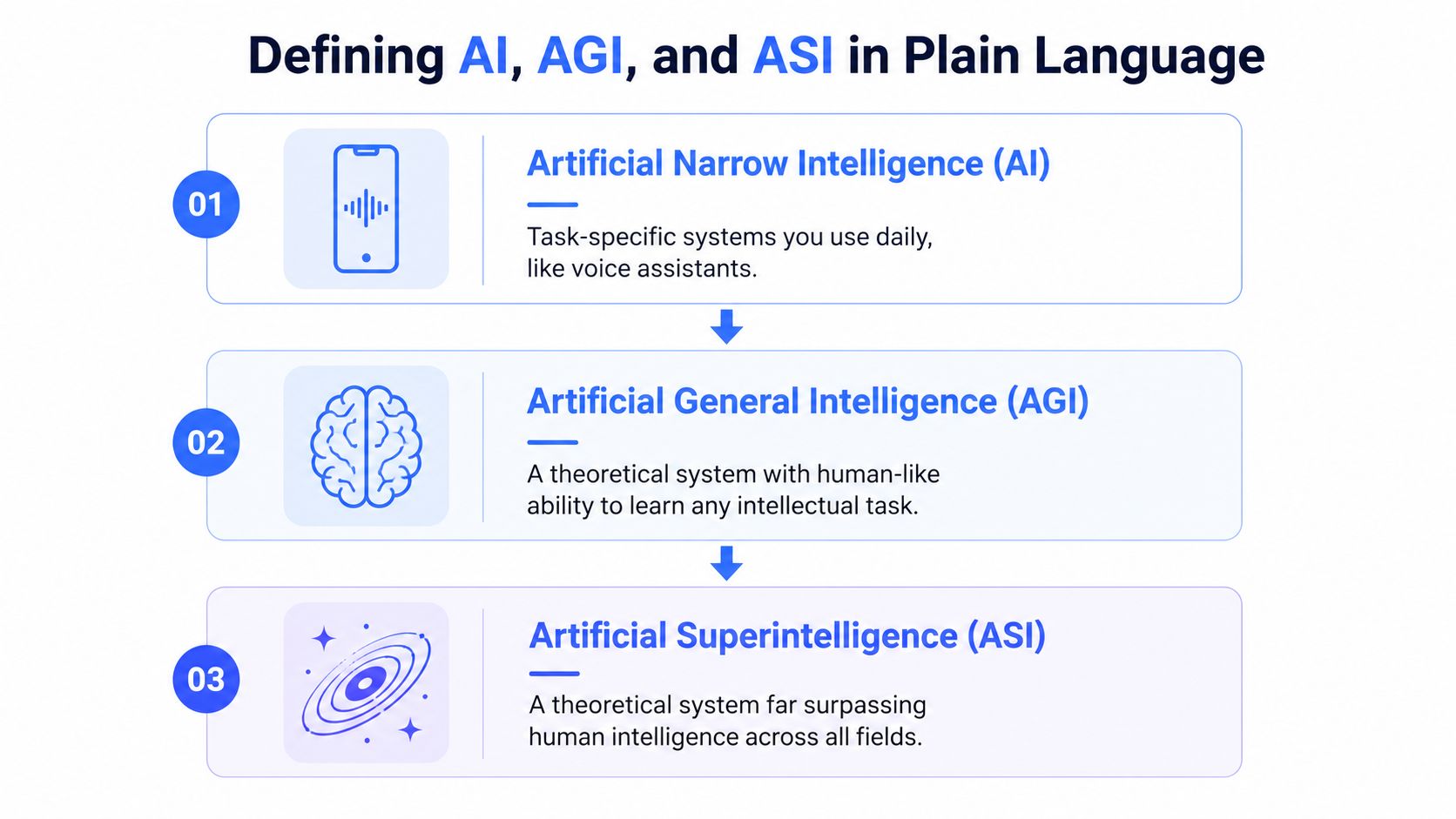
AI here means Artificial Narrow Intelligence, systems built to do specific tasks well. That includes voice-to-text, spam filters, recommendation engines, image classifiers, coding copilots, and language models that draft text inside a bounded workflow. For daily work, this is the category that matters now because it already slots into existing processes.
AGI means a system that can transfer learning across novel tasks without task-specific retraining. In plain English, it would pick up a new intellectual job and adapt the way a capable human does, without needing a separate model for every new problem. That is why AGI is treated as a general reasoning system, not just a better chatbot.
ASI means Artificial Superintelligence, a system that outperforms the best humans in every domain. The usual discussion around ASI assumes it might emerge if an AGI can improve itself fast enough, but that remains theory, not deployment.
The simplest way to keep the definitions straight is to map them to work. Narrow AI helps you transcribe a meeting, sort an inbox, or draft a memo. AGI would be the system you hand a brand-new project and expect it to learn the surrounding context. ASI would go beyond that and beat the strongest human strategy across every angle.
AGI isn't “better AI,” it's a different category of capability.
If you want a plain-English explainer that stays close to current product reality, the Voice Control Pro article on natural language processing is useful because it keeps the discussion anchored in how language systems handle everyday text work. For a sharper critique of hype, the ELECTE's Newsletter on AI hype makes the same point from another angle.
Current tools can already look broad because they span text, code, and images. That still does not make them general. Breadth of interface is not the same as general intelligence.
Capability Differences Across the Three Tiers
The easiest way to separate the three is by asking four questions, scope, autonomy, learning, and current status. That gives you a practical filter instead of a debate over labels.
| Criterion | AI (ANI) | AGI | ASI |
|---|---|---|---|
| Capability scope | Specific tasks, one domain at a time | Cross-domain intellectual work | Beyond the best human performance |
| Autonomy | Assisted, needs guardrails | Potentially autonomous across tasks | Theoretically highly autonomous |
| Learning style | Trained for a narrow job | Transfers learning to novel tasks | Often discussed as self-improving |
| Current status | Deployed at scale | Not yet achieved | Speculative |
Scope is the easiest tell. A narrow system can be excellent at one job and still fail when the input shifts. That's why current AI can outperform humans in single domains like image recognition or language tasks, yet still fall apart when the problem changes shape. AGI would need to keep working across those changes without being retrained for each one.
Autonomy is the second divider. Today's tools assist. They don't reliably own a project end to end. AGI would be able to take on broader task chains, make sense of unfamiliar steps, and keep going without constant human correction. ASI would push that much further, but that part of the discussion is still hypothetical.
Learning style matters more than most vendors admit. Narrow AI is built around training on a target pattern and then applying it inside that lane. AGI would need transferable learning, the ability to absorb one context and use it in another. ASI would imply a jump beyond that, often framed as recursive self-improvement.
Current status is the bluntest line. The verified historical fact is simple, all deployed AI today is ANI, while AGI is not yet achieved and ASI remains theoretical. That's the boundary that matters in product decisions.
If a system still needs a human to reframe the task every time, you're not looking at AGI. You're looking at a better narrow tool.
The right takeaway for teams is not to chase labels. It's to decide whether a tool is helping with one workflow, or whether it is starting to reduce the amount of context-switching your people have to do every day.
Real-World Milestones and Where the Real Boundary Sits
The field didn't jump from one day to AGI. It moved from symbolic AI to narrow machine learning, then to today's generative systems, and every stage stayed inside the narrow category. That's the historical pattern worth paying attention to.
The older symbolic era used rules and logic to solve specific problems. Narrow machine learning replaced many of those hand-built rules with statistical pattern recognition. Generative AI pushed further by making text and image generation feel fluid, which is why people started talking as if a new cognitive class had arrived. It hasn't.
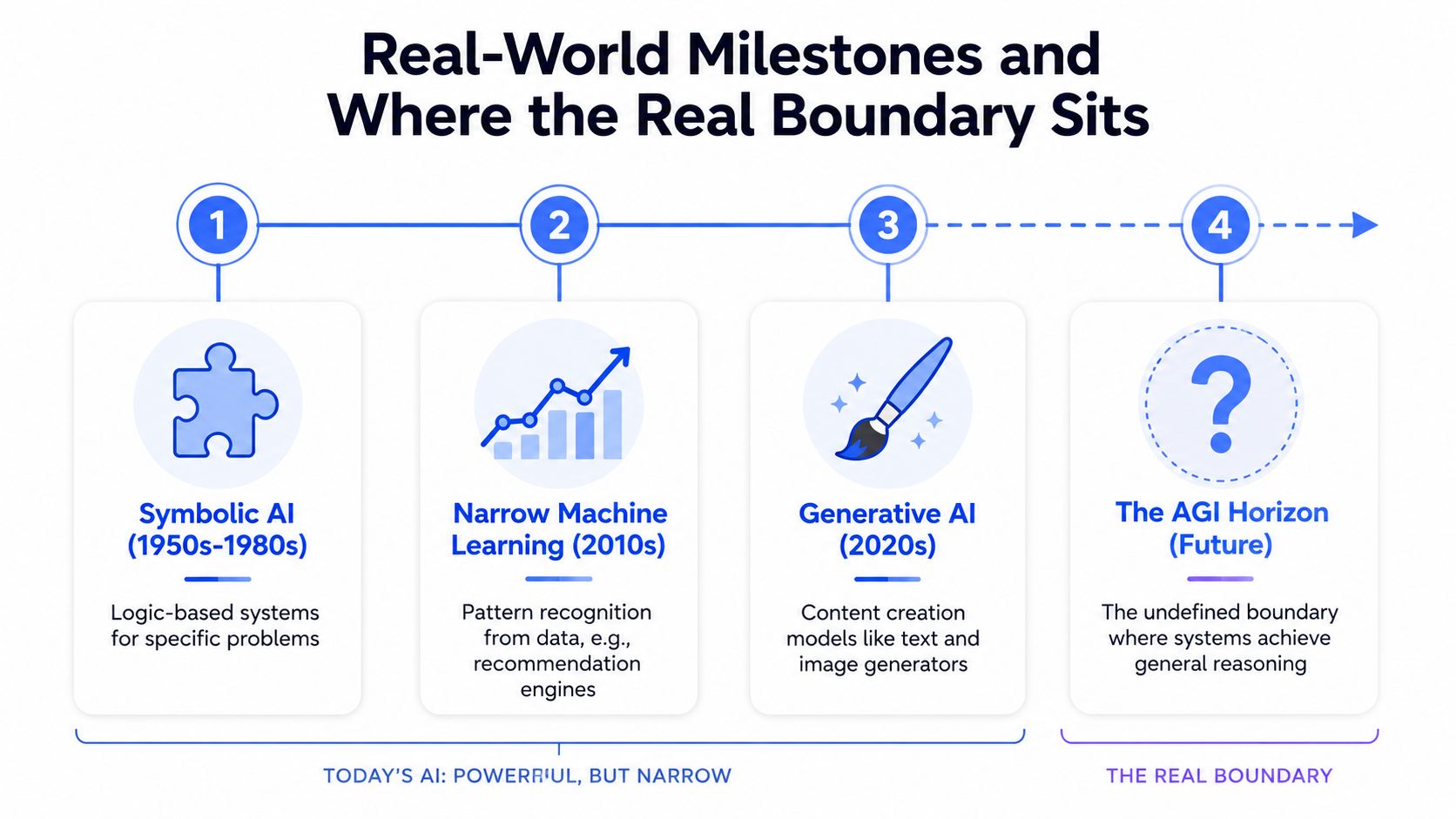
The boundary is not “it sounds smart.” The boundary is transfer learning across novel tasks without task-specific retraining. That is the line that separate narrow systems from general ones, and it's the line current products haven't crossed.
A few examples make the point. An image classifier can beat humans on a benchmark and still fail when the input distribution changes. A large language model can help with coding and summarization, yet still struggle to autonomously carry a multi-day project from first brief to final handoff. Those failures aren't bugs on the edge of AGI, they're proof the system is still operating in a narrow regime.
The same logic applies to language-first products. They can draft, rewrite, and summarize quickly, but they still need a human to set intent, validate output, and connect the result to the rest of the work. That's why using a tool like voice dictation AI chatbots is useful today. It cuts friction in the writing loop, but it doesn't magically create general intelligence.
A strong demo can hide a weak boundary. Watch the failure modes, not the marketing.
The milestone that matters next is not another polished release note. It's a system that can adapt across unfamiliar tasks without being retooled for each one. Until that happens, every product launch is still sitting inside narrow AI, no matter how impressive it looks in a demo.
Timelines, Probabilities, and How to Read the Forecasts
AGI timelines are noisy because people mix different kinds of forecasts. Some are based on lab intuition, some on expert surveys, and some on probabilistic forecasting platforms. If you read them as exact dates, you'll get misled fast.
The most visible public forecasts cluster around the late 2020s to 2040s. One industry roundup says major AI leaders point to 2026 to 2029 for AGI, while superforecasters and Metaculus are cited at about 25% probability by 2029 and 50% by 2033. Another survey-based reference says a 2025 review of expert surveys found that most scientists and industry experts expected AGI before 2100, while a separate analysis put current AI researchers around 2040.
That spread tells you more than any single year does. There is no consensus milestone, only a moving range. The window has shifted earlier over time, but it's still a range, not a calendar event.
ASI gets discussed differently. The common framing is 1 to 10 years after AGI if recursive self-improvement works the way optimists expect. That's a big if. It means ASI is usually treated as a second-order projection, not an independent near-term milestone.
For planning, that means you should treat AGI as medium-term and ASI as highly uncertain. Don't build operating plans around either one arriving on a fixed schedule. If a vendor or pundit gives you a hard year with absolute confidence, they're selling certainty they don't have.
A better way to read forecasts is to ask three questions.
- Who is making the call? A lab leader, a forecasting platform, and a survey of researchers aren't the same thing.
- What assumption drives the timeline? Compute, data, alignment progress, and architectural change all move the window differently.
- What would falsify the forecast? If the speaker can't say what would change their mind, the forecast is weak.
The practical posture is simple. Make decisions around the tools you can deploy now, keep an eye on the trajectory, and avoid business plans that assume general intelligence will solve today's workflow problems for you.
Risks, Ethics, and Governance Across the Three Tiers
The risk picture changes by tier, but the near-term danger is still the one teams live with. Narrow AI already creates problems through bias, hallucination, data leakage, and task-specific job displacement. Those are not abstract future issues, they're operational risks in current deployments.
AGI changes the stakes because broader capability means broader blast radius. The problems that matter there are alignment, capability evaluation, concentration of power, and economic disruption. If a system can generalize across tasks, then mistakes aren't confined to one workflow anymore. They spread.
ASI is where governance talk gets existential. The concern is recursive self-improvement, loss of control, and geopolitical competition over systems that outstrip human capability. That's why people talk about ASI in the same breath as international coordination, even though the category is still speculative.
The policy response has started, but it's uneven. Model evaluations, safety institutes, disclosure rules, and red-teaming are all part of the current governance stack. They're useful, but they're not a solved problem set. They're guardrails around systems that are still below AGI.
For knowledge workers, the most relevant governance question is inside your own company. Who approves AI output before it touches customers? Who owns data retention? Who checks whether a tool is keeping sensitive content where it shouldn't? The risk is not just what the model does, it's how your team uses it.
Cloud vs local speech recognition is a good example of how governance shows up in product choices. Where processing happens, and what leaves the machine, affects privacy posture in a very practical way.
The biggest governance mistake is treating every AI risk as if it belongs to the same future scenario.
Don't make your team wait for AGI to care about control. The serious work now is tightening review, clarifying data boundaries, and deciding which tasks can safely move faster and which ones need a human in the loop.
A Knowledge Worker's Playbook for the AI to AGI Window
Stop waiting for AGI to change your job. The gains available right now come from using narrow AI better, especially where it cuts typing, editing, and context-switching friction. That is the bottleneck in knowledge work.
Start with verification, not prompting tricks. If a system drafts faster than you can think, you still need a repeatable way to check facts, tone, and logic. Then design the workflow, because a tool that sits outside your process becomes another tab you ignore.
Voice-first work is one of the clearest examples. Dictation lets you capture ideas quickly, cleanly, and across apps without breaking momentum, which makes it one of the most useful narrow AI applications in daily work. The point is not magic intelligence, it is less friction between thought and draft.
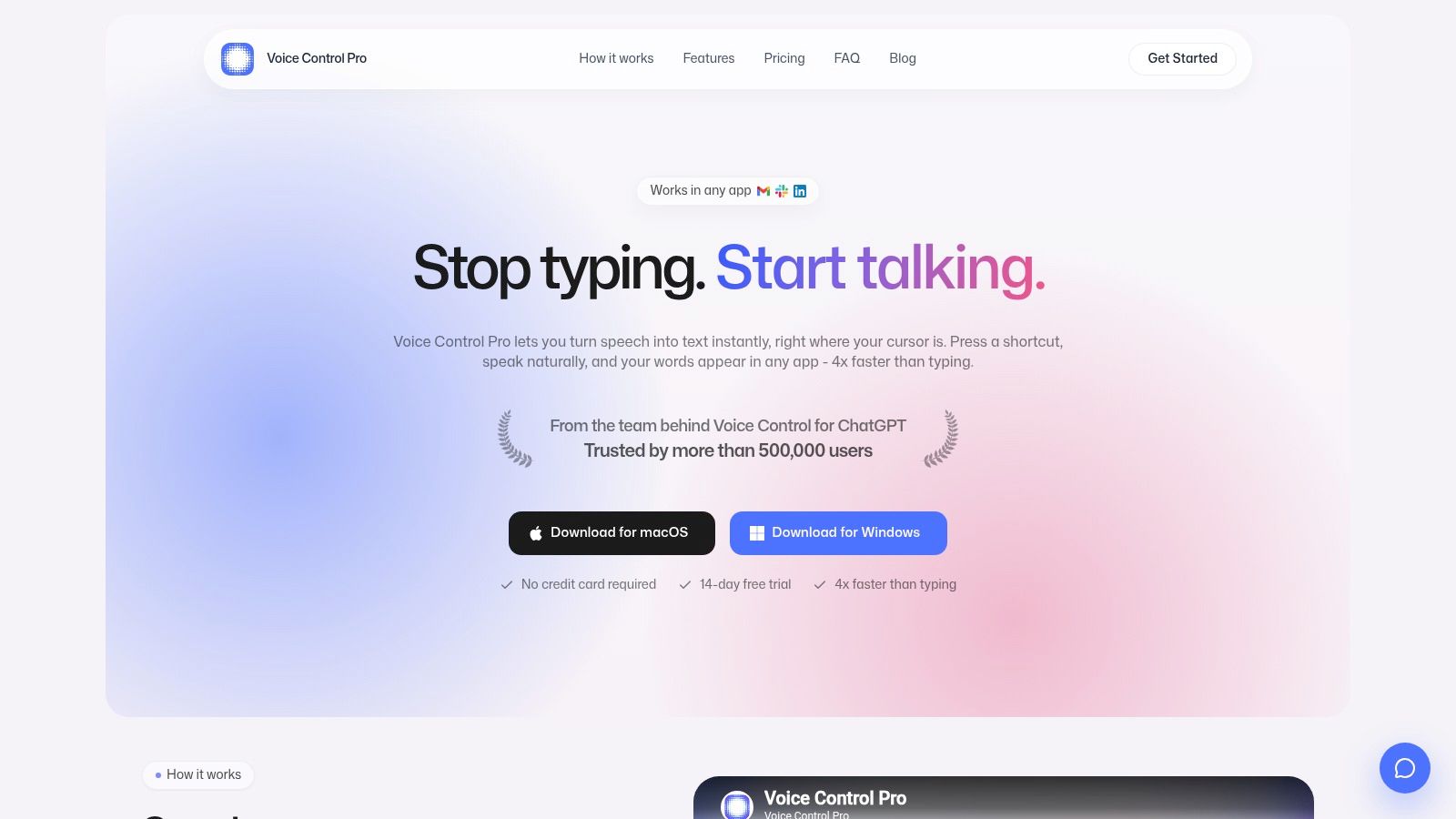
The publisher overview at Voice Control Pro describes a cross-platform setup built for speaking into any app, using a global shortcut, and inserting polished transcription directly at the cursor. That kind of flow matters because it shortens the distance between thought and draft. If your team writes a lot, that difference adds up fast.
Use AI for the unglamorous middle work too, rewriting a rough paragraph, tightening a meeting note, or turning screen context into a better prompt. That is far more useful than waiting around for a mythical general system to arrive.
Ignore vendor claims that suggest their product is basically AGI. Ignore doom threads that say every role disappears next quarter. Both pull attention away from the actual job, which is to make current systems reliable inside your stack.
The right posture is blunt. Use AI where it saves real time, verify where mistakes are expensive, and build habits around tools that lower the cost of getting words on the page. That is the window that matters before any AGI milestone shows up.
Frequently Asked Questions About AI vs AGI vs ASI
Has AGI already been achieved? No. The test would be simple in principle, a system would need to transfer learning across novel tasks without task-specific retraining and keep doing it reliably. Current products don't clear that bar.
What changes for a typical knowledge worker when AGI arrives? The biggest shift is workflow autonomy, not flashy intelligence. You'd hand off more multi-step work, but you'd still care about review, accountability, and integration with existing systems.
Should I worry about ASI in the next decade? Worry enough to support governance, not enough to blow up your career plan. ASI is still speculative, while the current operational gains and risks are happening in narrow AI right now.
A CTA for Voice Control Pro.