
Rewrite is the standard modern spelling in major dictionaries and style guides, while re-write is reserved for rare cases where a hyphen improves clarity. In ordinary emails, essays, reports, and software instructions, choose rewrite.
You've probably met the doubt at an awkward moment: the email is ready, the document needs one final pass, and suddenly the cursor stops after *re*. Should you ask a colleague to rewrite the paragraph, or ask them to re-write it? The hesitation is understandable because English keeps many older hyphenated forms, while modern usage often closes familiar prefix words.
The spelling question also hides a more useful question: how much should the text change? A request to “rewrite this” might mean correcting grammar, making a sentence shorter, changing its tone, or starting again with a new structure. Students, professionals, editors, and people using AI writing tools all face that choice.
This guide separates the spelling from the workflow. You'll learn why rewrite is the normal form, when re-write may still appear, how dictionaries and style preferences shape the choice, and how to decide whether a passage needs a light edit or a complete recreation.
Table of Contents
- Introduction Why This Spelling Trips Everyone Up
- Why the doubt feels reasonable
- What you'll be able to do
- What Rewrite Really Means and Why the Hyphen Fades
- Why older hyphens remain visible
- A useful mental rule
- Style Guide Preferences and When Re-Write Still Appears
- When a hyphen can help
- Light Edit or Full Recreation Understanding Rewrite Depth
- Three practical levels
- Match the instruction to the depth
- Correct Usage in Real Sentences and Common Mistakes to Avoid
- Before and after
- A quick proofread
- How Voice Control Pro Helps You Rewrite Faster Without Losing Your Voice
- Preserve the thinking behind the draft
- Use privacy-aware iteration
Introduction Why This Spelling Trips Everyone Up
Consider a student reviewing an essay before submission. The argument is sound, but one paragraph feels repetitive. They type, “I need to re-write this section,” then pause. A marketing manager may have the same reaction while preparing a product announcement, especially after switching between a company style guide, a word processor, and an AI assistant that offers several rewrite options.
The practical answer is simple: write “rewrite” as one word in nearly every everyday context. The closed spelling works as both a verb and a noun:
I'll rewrite the introduction before lunch.
The editor requested a rewrite of the opening paragraph.
The hyphenated form isn't usually a meaning error. Readers will understand *re-write*, and older texts or specialized house styles may preserve it. Yet it's not the form most readers expect in current general English, so using the closed version keeps your writing natural and avoids an unnecessary visual interruption.
Why the doubt feels reasonable
The prefix re- means “again” or “back,” which makes *re-write* look logical. English also uses hyphens to show that a prefix belongs to a base word, particularly when the combined form could confuse readers. Because those situations exist, writers often apply the hyphen more widely than needed.
The confusion has become more noticeable as writing software breaks rewriting into actions such as rephrase, simplify, polish, shorten, enrich, and modify tone. The button may say “rewrite,” but the user still has to decide whether the task is a correction, a transformation, or a fresh draft.
What you'll be able to do
By the end, you'll have two quick habits:
- For spelling: use *rewrite* unless a trusted house style gives a specific reason to do otherwise.
- For editing: define the requested change before touching the sentence. “Make it clearer” calls for a different pass than “rebuild the argument.”
That distinction matters more than the hyphen itself. A clean spelling choice helps readers, while a clear rewrite brief helps writers produce the right result.
What Rewrite Really Means and Why the Hyphen Fades
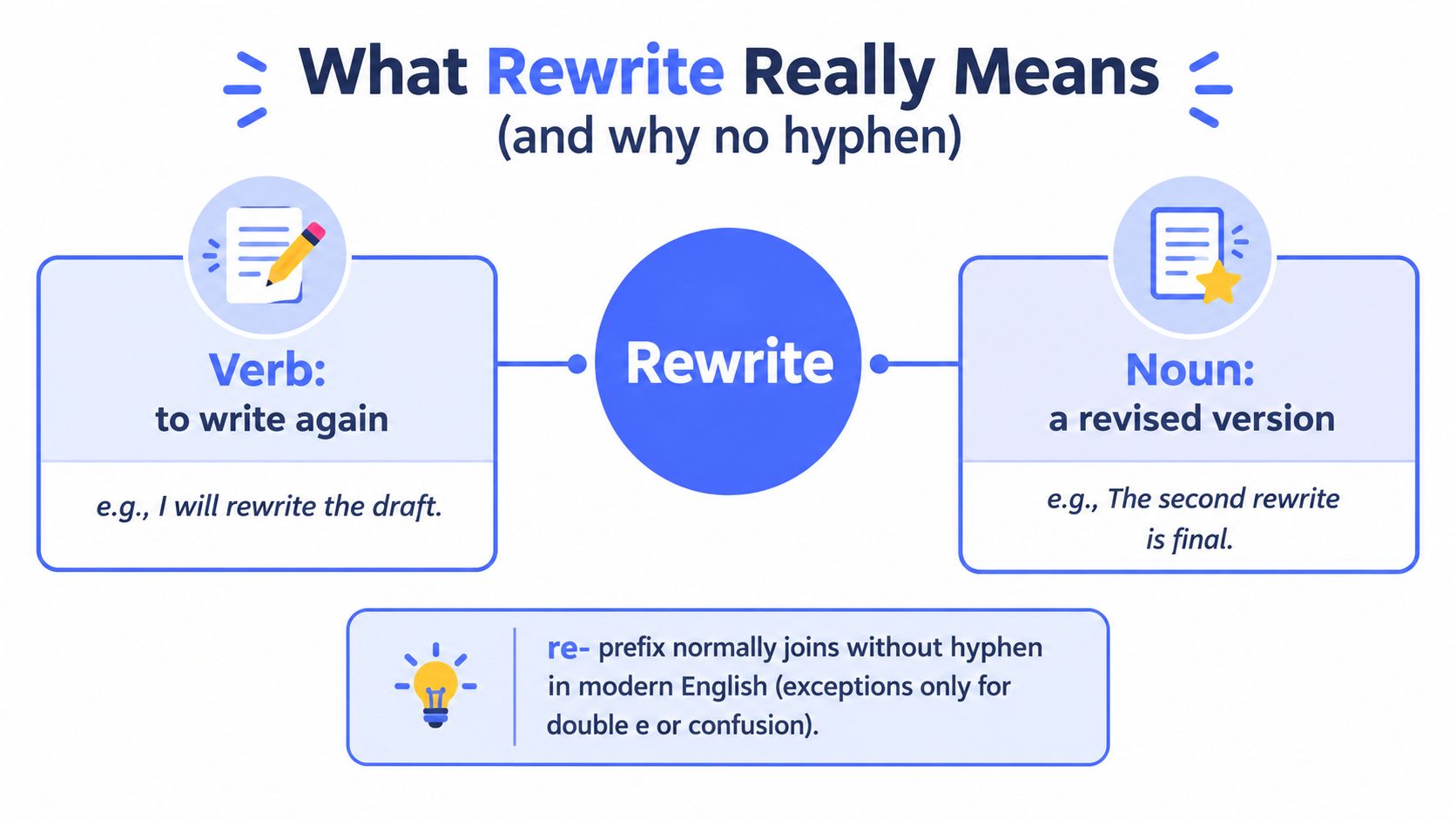
Rewrite has two common grammatical roles. As a verb, it means to write something again, revise it, or express it in a different way. As a noun, it means the revised text or the act of revising it.
The prefix pattern explains the spelling. In modern English, re- usually joins the base word directly:
- reuse
- rebuild
- reread
- rethink
- rewrite
This is similar to attaching a label to a folder. If the label and folder make a familiar combination, English generally keeps them together. The result is easier to recognize as one established word.
Why older hyphens remain visible
Hyphenation has never been perfectly uniform. Earlier editors often used hyphens to make a prefix boundary visible, especially when a word was new, uncommon, or likely to be misread. As readers became familiar with combinations such as *rebuild* and *rewrite*, the visual support became less necessary.
That history explains why re-write can look acceptable even though rewrite is now the ordinary headword. The hyphen signals the same basic idea, but it gives the word an older or more deliberate appearance. It may also appear when an editor wants to emphasize “write again” rather than another possible meaning, although ordinary context usually does that work naturally.
A dictionary definition tells you what a word means, but it doesn't always tell you how to choose among modern workflow options. For practical business communication, resources such as insights for entrepreneurs can provide broader guidance on communicating clearly while you revise documents, messages, and ideas.
A useful mental rule
Think of rewrite as the default and re-write as a deliberate exception. If you're describing a normal revision, the closed word is the safe choice:
Please rewrite the final paragraph.
I rewrote the proposal after the client meeting.
This rewrite preserves the original recommendation.
The spelling doesn't determine the depth of the work. A rewrite can be a sentence-level adjustment or a substantial new draft. The word stays closed even when the editorial task becomes large.
Style Guide Preferences and When Re-Write Still Appears
Major dictionaries generally present rewrite as the standard form. Merriam-Webster lists *rewrite* as a verb meaning to write again or revise, while the Oxford Learner's Dictionaries entry also treats it as a single word. These references support the everyday choice used in general American and British writing.
Style guides tend to follow the same practical direction. The Associated Press and Chicago approaches usually avoid unnecessary hyphens in familiar compounds, while allowing punctuation when it prevents confusion or makes a passage easier to read. The guiding principle isn't “never hyphenate.” It's “don't add a mark that readers don't need.”
| Dictionary and Style Guide Preference for Rewrite | Preferred Form | Notes |
|---|---|---|
| Merriam-Webster | rewrite | Lists the closed form as the main dictionary entry. |
| Oxford Learner's Dictionaries | rewrite | Treats the word as a standard verb meaning to write again or revise. |
| Associated Press style | rewrite | Familiar prefix forms generally appear closed unless clarity suffers. |
| Chicago style | rewrite | Avoids needless hyphenation while permitting a hyphen for readability. |
When a hyphen can help
The main exceptions involve potential confusion. A writer may use a hyphen when a prefixed word could be misread, when the base word begins with a difficult vowel sequence, or when a specialized publication has a fixed spelling policy. Those cases depend on context rather than a universal rule.
For example, a technical editor may choose a hyphen temporarily in a sentence where the closed form creates an awkward visual collision. That doesn't make *re-write* the preferred everyday spelling. It means the editor has chosen readability over the default pattern.
Fast decision test: If you mean “write again” and ordinary context makes that meaning clear, write rewrite.
Consistency matters, too. Don't use *rewrite* in one heading and *re-write* in another unless you're intentionally discussing the variant. A custom dictionary can help enforce preferred forms across repeated work, and this guide to creating a custom dictionary offers practical context for managing specialized vocabulary.
Light Edit or Full Recreation Understanding Rewrite Depth
Spelling tells readers how the word is formed. It doesn't tell them what kind of work you expect. When someone asks for a rewrite, they may want a few surface changes, a new organization, or a completely fresh version built from the same underlying idea.
A large peer-reviewed benchmark on text rewriting found that most evaluated tasks had word-level edit ratios higher than 50%, meaning more than half of the source text changed at the word level in many benchmark cases (OpenRewriteEval research). That finding helps explain why rewriting is treated as a distinct natural-language-processing task rather than a simple synonym swap.
Three practical levels
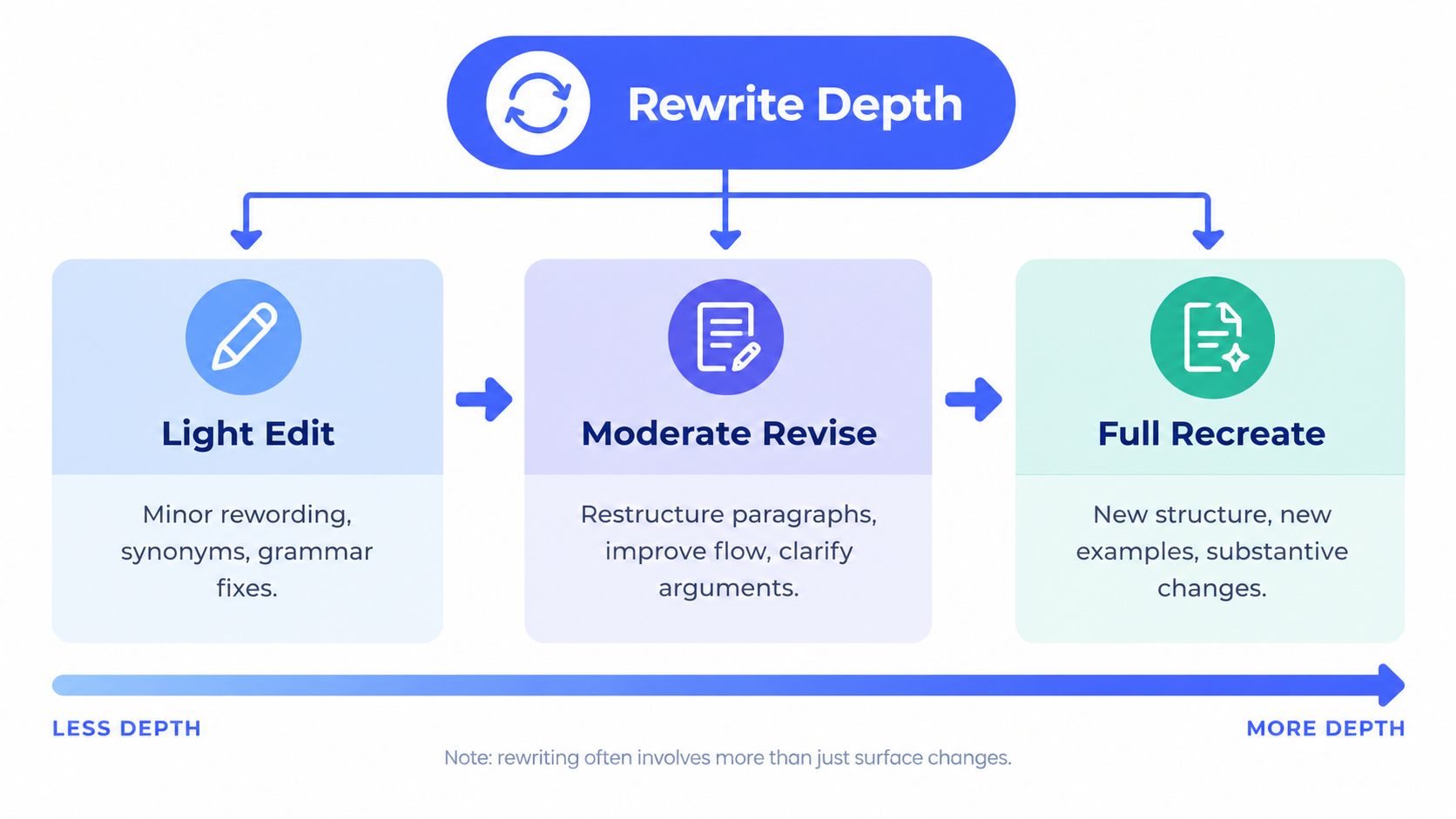
Light edit keeps the structure and message mostly intact. You might repair grammar, remove repetition, replace a vague verb, or improve a transition.
Original: “We are writing to let you know that your request has been received by our team.”
Light rewrite: “We've received your request.”
Moderate revision changes the order or emphasis. You might combine short paragraphs, move the main point forward, or replace technical language with terms a customer can understand. The facts remain, but the reader's path through them improves.
Full recreation uses the source as raw material. The writer may choose a new opening, reorganize the argument, add different examples, and change the voice substantially. This approach suits a document written for a different audience or a draft whose structure no longer serves its purpose.
Match the instruction to the depth
Modern rewrite tools increasingly divide a general request into more precise actions. Choose polish for grammar and flow, shorten for compression, simplify for accessibility, rephrase for variation, and tone shift when the audience or relationship changes. A request such as “make this more neutral” gives better direction than “rewrite this” because it names the intended transformation.
The purpose also sets the boundary. A support reply should preserve the customer's facts and commitments. A research introduction may need tighter logic and clearer claims. A creative passage may benefit from a completely new rhythm.
For people who draft by speaking, editing by voice on desktop can make it easier to test several versions without stopping to retype every sentence. The important safeguard remains human judgment: check meaning, factual accuracy, and voice after any substantial rewrite.
Correct Usage in Real Sentences and Common Mistakes to Avoid
The easiest way to master rewrite is to see it doing ordinary grammatical work. It behaves like other familiar verbs, so its past tense is rewrote, and its participle is rewritten.
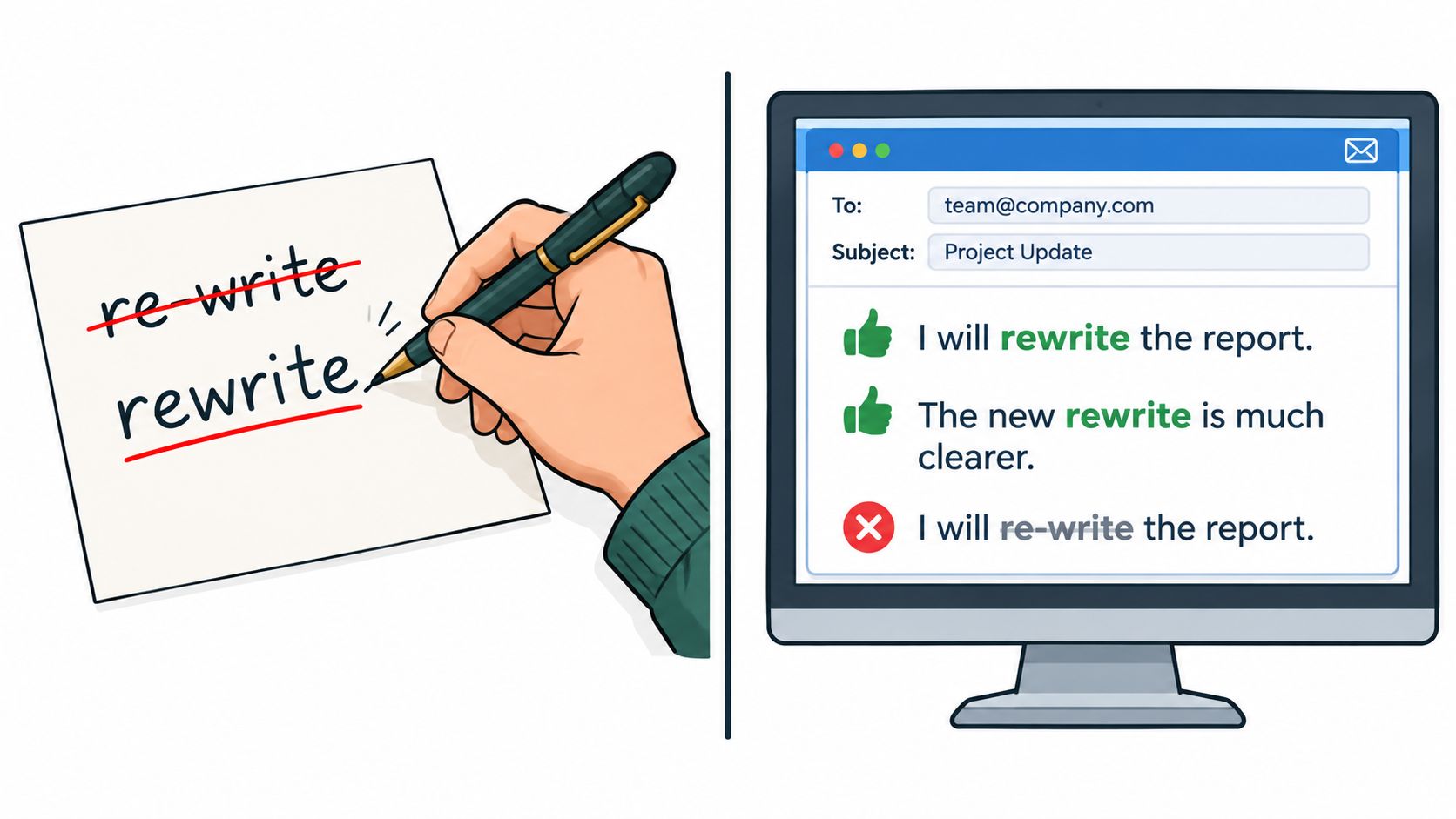
Verb: Please rewrite the subject line so the request is clear.
Past tense: I rewrote the introduction after receiving feedback.
Participle: The report has been rewritten for a nontechnical audience.
As a noun, *rewrite* names the new version or the editorial task:
The editor asked for a rewrite.
This rewrite has a clearer conclusion.
Before and after
Hyphenated default
Less natural: “Can you re-write the email?”
Preferred: “Can you rewrite the email?”
Inconsistent document style
Less consistent: “The first draft needs a rewrite, but the next section needs a re-write.”
Preferred: “The first draft needs a rewrite, and the next section needs another rewrite.”
Incorrect verb form
Incorrect: “I have rewrote the paragraph.”
Preferred: “I have rewritten the paragraph.”
Unclear instruction
Vague: “Rewrite this.”
Better: “Rewrite this in a shorter, friendlier tone while keeping the delivery date.”
A quick proofread
Search your document for re-write, then ask three questions:
- Meaning: Does the word mean “write again” or “revise”?
- Context: Is there a real risk that the closed form will confuse readers?
- Consistency: Have you used the same form everywhere else?
If the answer is ordinary revision, replace the hyphenated version with rewrite. For broader proofreading habits, Resumey.Pro's error avoidance advice for professional documents can help you catch inconsistent wording alongside spelling and formatting mistakes.
How Voice Control Pro Helps You Rewrite Faster Without Losing Your Voice
Knowing the correct spelling is useful, but the larger advantage comes from giving each revision a precise purpose. A voice-to-text workflow lets you capture the thought first, then ask for a targeted change without rebuilding the sentence manually.
Voice Control Pro works across apps by letting you press and hold a global shortcut, speak naturally, and release the shortcut to insert cleaned transcription wherever the cursor is placed. Its Hey Max assistant can work with selected text, so you can highlight a paragraph and request a clearer, shorter, more neutral, or more polished version without switching windows.
Preserve the thinking behind the draft
Voice drafting can help writers get ideas out before they over-edit them. That matters for an email, a report, a study note, or a longer project where the first version needs to preserve the writer's natural reasoning. A later request such as “shorten this but keep the recommendation” separates content preservation from surface improvement.
That separation also protects authenticity. A polished rewrite should still sound like the person sending it, not like an anonymous template. If you're developing a sustained argument, a guide such as Storyloft's philosophy book writing resource can offer useful perspective on maintaining a coherent voice across substantial drafts.
Use privacy-aware iteration
Voice Control Pro includes Fly Mode, which runs processing locally on the computer and pauses cloud features. That option can suit drafts containing sensitive workplace, client, or research material. The product also offers a local mode for unlimited dictation with an on-device AI model, while its advanced features include language support, cleanup levels, a custom dictionary, transcription history, and Hey Max tools.
For a practical walkthrough, see how to rewrite selected text by voice in any app. The central habit is simple: say what should change, specify what must stay, and review the result before sending it.
Voice Control Pro lets you dictate polished text wherever your cursor sits, then refine selected writing by voice for clarity, brevity, or tone. Visit Voice Control Pro to try a faster rewrite workflow while keeping control of your wording, privacy, and personal voice.