
You're drafting a sentence and the list looks ordinary until the punctuation stops feeling ordinary. Three items, one of them already has a comma inside it, and suddenly the comma you've used all day looks too small for the job. That's the moment when punctuating lists in sentences stops being a memory test and starts being a judgment call about clarity.
The good news is that the choice usually follows a simple logic. Commas handle simple series, semicolons step in when items are already busy with internal commas, and a colon opens the door when a complete sentence leads into the list. Once you see that pattern, you can make the sentence easier to read instead of just making it “look right.”
Table of Contents
- The Moment a Comma Suddenly Feels Wrong
- Why the same sentence can take two different forms
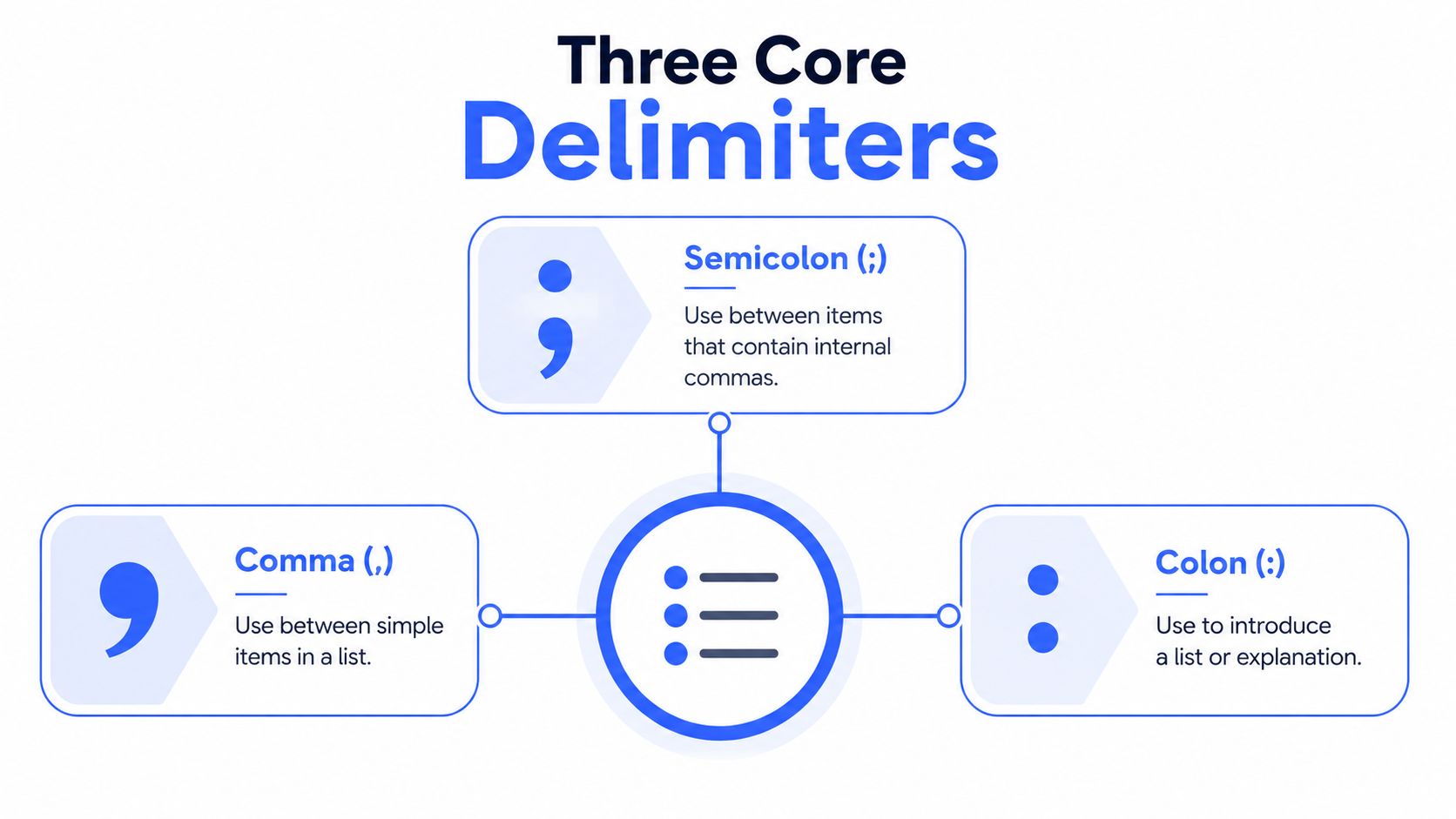
- Three Core Delimiters and When Each One Wins
- Commas for simple items
- Semicolons for items that already contain commas
- Colons for complete lead-ins
- A note on the Oxford comma
- What Counts as a Complex Item
- Start by counting internal commas
- Use a rewrite test, not a label
- Parallel structure still matters
- How Chicago, AP, and MLA Handle the Same Sentence
- Where the guides line up
- Where the differences matter
- A practical way to stay consistent
- Bullet and Numbered Lists as a Separate System
- Sentence lists and fragment lists are not interchangeable
- Bullets and numbers signal different relationships
- When to break the sentence into a vertical list
- Four Mistakes That Sneak Past Most Writers
- Mixing delimiters inside one list
- Using a colon after a fragment
- Letting parallel structure drift
- Forgetting that two items are different from three
- List Punctuation in Voice-to-Text and Dictation Workflows
- Quick Reference and Frequently Asked Edge Cases
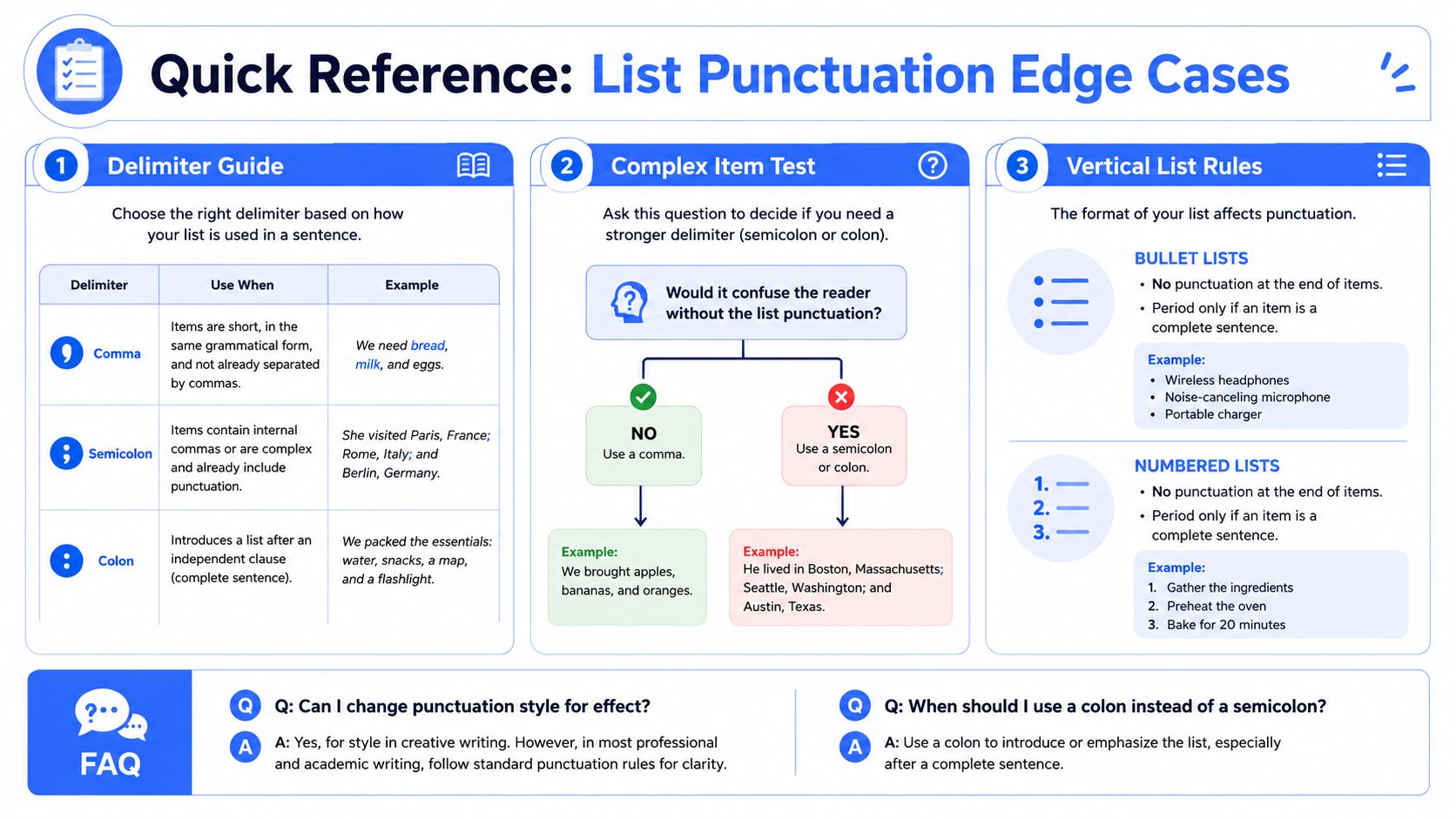
- Quick reference
- FAQ
The Moment a Comma Suddenly Feels Wrong
A student writes, “The report covered sales, marketing, customer support, and onboarding.” That sentence looks harmless until one item turns into “customer support in Dublin, London, and Manchester.” At that point, the commas stop doing clean work, because a reader can no longer tell which marks belong inside the item and which marks separate the items.
That is the problem in miniature. List punctuation is disambiguation, the set of marks that keeps readers from stumbling over boundaries they cannot see. Purdue OWL treats this as standard list punctuation practice, not an optional flourish, and the guidance matches the rule taught across academic and government style references, simple series use commas, while complex items need semicolons, and a complete lead-in can take a colon before the list begins.
Why the same sentence can take two different forms
The sentence shape matters as much as the items themselves. If every item is short and clean, commas keep the line moving. If an item already contains its own comma, the separator has to become stronger, or the reader loses the boundary.
Practical rule: choose the mark that makes the list easier to parse on the first read, not the one that feels most familiar.
Many writers assume punctuation in lists is a matter of preference. It is not. The choice tells the reader how to group the words, which is why the same three-item pattern can be correct with commas in one version and semicolons in another. Once you start reading for boundaries instead of appearances, the rule stops feeling arbitrary.
Three Core Delimiters and When Each One Wins
A list can look tidy on the page and still confuse the reader. The difference usually comes down to which delimiter is doing the separating. The comma, the semicolon, and the colon each solve a different boundary problem, so the right choice depends on how much structure the sentence already contains.
Commas for simple items
Use a comma for a simple series when each item is short and self-contained. In that setting, the comma keeps the sentence moving without drawing attention to itself. Purdue OWL list formatting guidance treats this as the normal choice for in-sentence series of three or more items.
Correct: The team reviewed scope, timeline, and budget. Wrong: The team reviewed scope; timeline; and budget.
The second version feels heavier because the mark is stronger than the structure requires. It is like using a full stop where a light tap would do the job.
Semicolons for items that already contain commas
Once a list item already includes a comma, the boundary marks start competing with one another. That is when a semicolon becomes the clearer separator. Briefcatch's punctuation guidance points to semicolons for list items that contain commas or for complex clauses, which is why legal, academic, and policy writing so often uses them (Briefcatch on punctuation in lists).
| Sentence type | Clear version | Confusing version |
|---|---|---|
| Simple items | The itinerary included Paris, Berlin, and Vienna. | The itinerary included Paris; Berlin; and Vienna. |
| Items with internal commas | The itinerary included Paris, France; Berlin, Germany; and Vienna, Austria. | The itinerary included Paris, France, Berlin, Germany, and Vienna, Austria. |
The difference is not cosmetic. In the second row, semicolons act like separate fence posts, so the reader can see where one location ends and the next begins. In the confusing version, the same comma has to do two jobs at once, and that slows reading.
Colons for complete lead-ins
A colon works when the sentence before the list is already complete and the list is about to follow. The lead-in should stand on its own first, then the colon signals that the sentence is opening into a set of items. That standard pattern is described in Purdue OWL's list guidance as well (Purdue OWL list formatting guidance).
Correct: The editor asked for three changes: shorter paragraphs, cleaner transitions, and fewer passive verbs. Wrong: The editor asked for three changes, shorter paragraphs, cleaner transitions, and fewer passive verbs.
The comma version blurs the handoff between the setup and the list. The colon makes the boundary visible, which is useful any time the lead-in is complete and the items are the point.
A note on the Oxford comma
The Oxford comma is a style choice, not a universal correctness issue. In a simple series, some styles include it before the final and, and some omit it. What matters is that the list stays parallel and unambiguous.
If your final item could be read as part of the item before it, the extra comma often earns its keep.
That is why the skill is not memorizing one pattern and using it everywhere. It is choosing the delimiter that removes doubt from the sentence on the first read.
What Counts as a Complex Item
A list item becomes complex when a reader has to slow down to see where that item stops and the next one starts. An internal comma is the clearest signal, but the issue is broader than that. Once the items contain their own punctuation, or the wording starts to crowd the boundaries, commas begin to do two jobs at once, and the sentence becomes harder to parse.
Start by counting internal commas
If an item already contains a comma, using commas between items creates visual noise. The same mark is now separating items and also sitting inside an item, so the reader has to sort out which comma matters where. In practice, that is why semicolons show up so often in legal, academic, and policy writing. They separate units that would otherwise blur together, especially in nested or clause-heavy lists.
Simple: We met in Boston, Chicago, and Seattle. Complex: We met in Boston, Massachusetts; Chicago, Illinois; and Seattle, Washington.
The second sentence is easier to scan because each boundary stays visible. A legal brief or technical specification often depends on that kind of clarity, because one misplaced boundary can change how a reader groups names, duties, or exceptions.
Use a rewrite test, not a label
Before: The contract covered clauses on termination, renewal, and notice. After: The contract covered clauses on termination; renewal; and notice when the parties disputed timing in the final draft.
The second version is not better because it sounds more formal. It is better because the punctuation now matches the shape of the information. When a list item starts carrying its own clause or embedded explanation, the reader needs a delimiter that separates the items without competing with the punctuation already inside them.
That same logic is why dictation tools can produce different results from typed text. A writer can look at a sentence and insert a semicolon by instinct, but voice input often delivers a stream of words first and lets the software decide where the breaks land. If the spoken phrase is long and packed with internal pauses, the software may need extra cleanup because it does not always hear the boundary the way a careful editor sees it on the page.
Parallel structure still matters
A semicolon does not fix uneven grammar. If one item is a noun phrase, the next is a clause, and the third is a string of modifiers, the list will still feel lopsided even when the punctuation is technically correct. Style guides keep pushing parallel structure for a reason, the reader scans faster when each item has the same shape.
The best version of a complex list is not just punctuated correctly. It is built so the punctuation can do a clean job.
How Chicago, AP, and MLA Handle the Same Sentence
Chicago, AP, and MLA are not three different planets. On list punctuation, they mostly share the same gravity. They agree on the broad logic, simple items use commas, complex items often need semicolons, and a complete lead-in can take a colon, while the differences show up in a few style decisions such as the serial comma and house preferences for bullet treatment.
Where the guides line up
The main overlap is bigger than most writers expect. All three systems want the list to be readable, internally consistent, and parallel. That's why the practical advice for teams is to choose a house style and apply it the same way across the document set. If your organization works across multiple audiences, a documented style guide makes those choices repeatable, and this article on adopting a documentation style guide is useful because it frames style as a team habit, not a one-off editorial decision.
Where the differences matter
The serial comma is the best-known split, and it's the one readers notice most quickly. Some publications want it, some don't. For writers who jump between academic papers, newsroom copy, and internal documentation, the safest move is to follow the guide that governs the venue, not the one you happen to prefer.
| Rule | Chicago | AP | MLA |
|---|---|---|---|
| Simple in-sentence series | Uses commas | Uses commas | Uses commas |
| Complex items with internal commas | Uses semicolons | Uses semicolons when clarity requires it | Uses semicolons |
| Colon before a list after a complete sentence | Allowed | Commonly used in many writing contexts | Allowed |
| Serial comma | Style-dependent | Style-dependent | Style-dependent |
The table shows the useful truth, most of the time, the guides are closer than people think.
A practical way to stay consistent
Pick one guide, write it down, and enforce it in templates, training notes, and review checklists. When teams skip that step, editors end up arguing over commas that should have been settled at the system level. Consistency matters because the reader experiences the document as a whole, not as a patchwork of individual sentence decisions.
Bullet and Numbered Lists as a Separate System
A vertical list looks simple on the page, but the punctuation inside it follows a different logic from a sentence tucked into a paragraph. The Australian Government Style Manual separates sentence lists from fragment lists, and that split changes capitalization, terminal punctuation, and the way the final stop works (Australian Government Style Manual list guidance).
Sentence lists and fragment lists are not interchangeable
A sentence list uses complete sentences as items. Each item starts with a capital letter and ends with a full stop. A fragment list uses phrases or incomplete units, so the punctuation is lighter, and only the final item takes terminal punctuation in the Australian style guidance. Purdue OWL makes the same underlying point in a different way, complete-sentence items need capitalization and punctuation, while non-sentence items do not follow the same pattern.
Sentence list:
- The client approved the outline.
- The client requested more examples.
- The client asked for a faster turnaround.
Fragment list:
- More examples
- A faster turnaround
- Clearer headings
The difference is visible in the first letter and the last mark. In the sentence list, each item behaves like a full thought. In the fragment list, the items behave more like labels.
A small edit shows the contrast clearly. Compare Revise the draft. with a fragment list such as revisions, approvals, and delivery notes. The first item needs capitalization and a full stop because it stands alone as a sentence. The second list works as a set of phrases, so the punctuation stays lighter.
Bullets and numbers signal different relationships
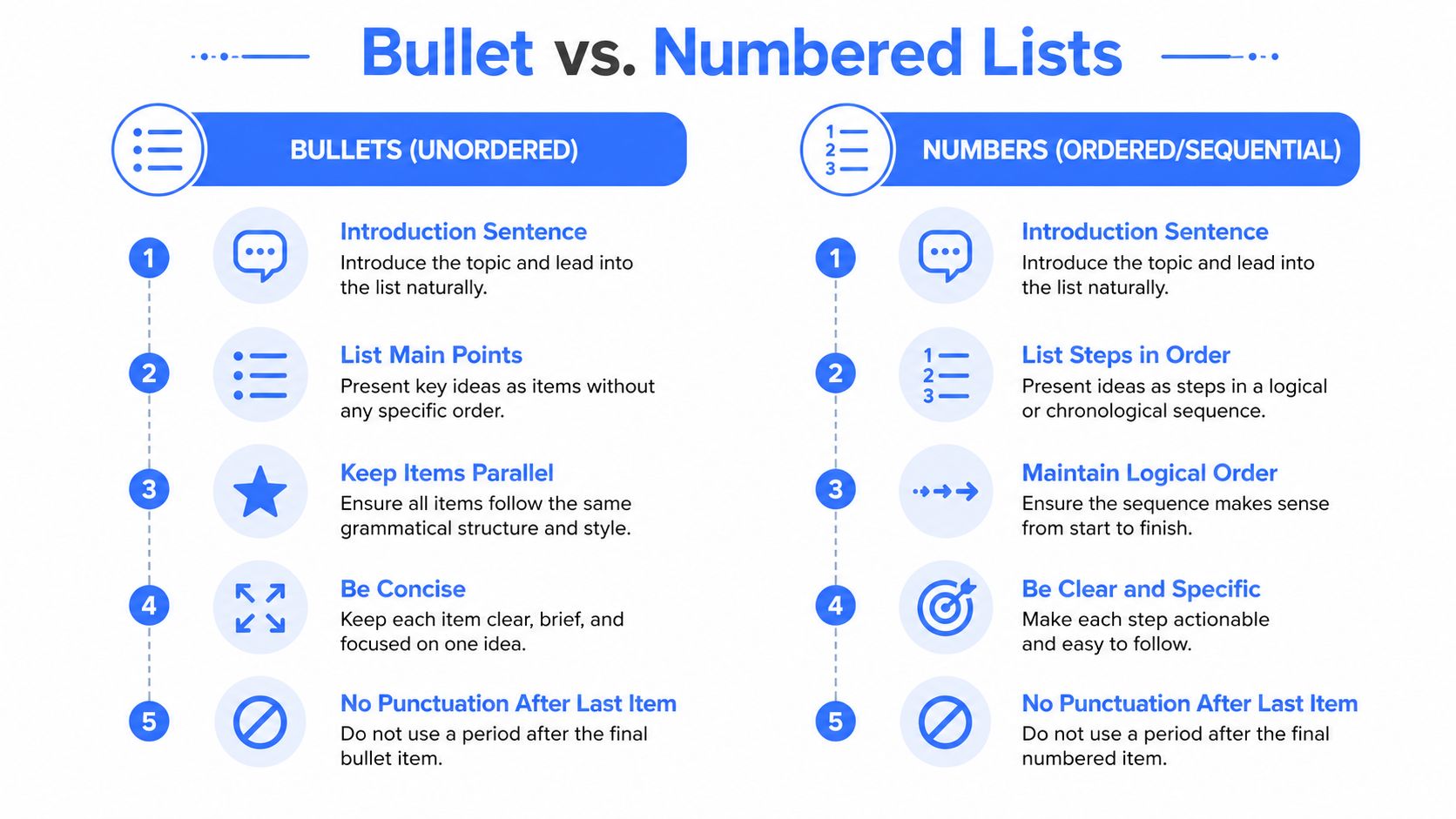
Bullets usually signal items of equal weight. Numbers signal sequence, order, or priority. That distinction matters because a reader uses the format to infer the job of the list before reading every line. If order matters, numbers help the reader follow the steps without guessing.
A recipe makes the difference plain. If you are listing ingredients, bullets are usually the better fit because the items are peers. If you are listing what happens next, numbers make the order visible, step by step, so the reader can see which action comes first and which one depends on the last.
The opening sentence matters too. A clean lead-in tells the reader why the list exists, and a vertical list makes punctuation decisions more visible because each item stands apart. That is why a list is not only a formatting choice, it is also a grammar choice that tells the reader how to read the items.
How to proofread dictated text faster on desktop becomes especially useful here, because dictation tools often expose list punctuation mistakes that typing can hide for a while.
When to break the sentence into a vertical list
Break the sentence when the items need breathing room, when the order matters, or when the list is long enough to slow a reader down in paragraph form. If the items are short and the sentence still reads smoothly, keeping them inline can be the better choice. If the items start to feel like a stack of clauses, moving them into bullets usually improves scannability.
A vertical list also helps when the items would otherwise compete with one another inside a long sentence. Legal writing often uses semicolons for that reason, because semicolons separate complex items without making the reader lose track of where one item ends and the next begins. In a paragraph, that punctuation does the disambiguating work. In a bulleted or numbered list, the layout itself carries part of that burden.
A vertical list is a formatting choice, but it changes the grammar the reader expects.
That is why it helps to choose the format deliberately instead of dropping bullets in just because the sentence feels crowded.
Four Mistakes That Sneak Past Most Writers
The most common list errors don't come from ignorance, they come from overconfidence. Writers know the rough rule, then make a small exception in a sentence that happens to be the worst place for a mistake.
Mixing delimiters inside one list
A list that starts with commas and ends with a semicolon or colon usually signals that the writer changed strategies halfway through. Read the sentence aloud and mark where each item starts. If the marks don't match the structure, the punctuation needs a reset.
Wrong: We need clarity, accuracy; and consistency. Better: We need clarity, accuracy, and consistency.
Using a colon after a fragment
A colon needs a strong lead-in. If the words before it don't form a complete thought, the list after it can feel dropped into place. That's why the colon is a bridge, not a decorative pause.
Wrong: For the project: revisions, approvals, and final delivery. Better: The project requires revisions, approvals, and final delivery.
Letting parallel structure drift
A list loses force when the items change form halfway through. One item as a noun phrase, another as an infinitive, and a third as a full clause makes the reader do extra grammar work. The punctuation may be fine, but the sentence still feels uneven.
Forgetting that two items are different from three
Most of the time, a list of two items doesn't need the same machinery as a three-item series. That's where writers sometimes overbuild the sentence and add punctuation that doesn't help. If the sentence is just pairing two ideas, keep it simple unless the house style says otherwise.
For a quick proofing pass, the workflow advice in this proofreading guide is especially useful if you review aloud, because it trains you to hear where the sentence breaks.
List Punctuation in Voice-to-Text and Dictation Workflows
Dictation changes the game because punctuation has to be spoken, not just chosen. Commas often arrive too easily, semicolons can get skipped, and a colon may not appear unless you name it out loud or pause in a way the engine interprets correctly. If you dictate regularly, the safest habit is to build the list in a parallel way and then review the punctuation as a separate pass.
A practical dictation routine is to speak the items in matching grammatical form, then say the punctuation marks by name when the boundary matters. The guidance in how to dictate punctuation and paragraphs clearly is useful here because it treats punctuation as part of the spoken draft, not an afterthought. That matters for accessibility too, since screen readers and transcription tools can announce inline and vertical lists differently when the punctuation is inconsistent.
Quick Reference and Frequently Asked Edge Cases
Quick reference
- Comma: use for simple in-sentence series.
- Semicolon: use when items already contain commas or clauses are long and complex.
- Colon: use after a complete lead-in that introduces the list.
- Vertical lists: keep capitalization and terminal punctuation consistent with the item type.
FAQ
How do I punctuate a list of two items? Most American-style usage doesn't require a comma between only two items. If the items are simple, keep the sentence clean and let the conjunction do the work.
What happens when a list sits inside another list? Use the stronger delimiter to separate the larger units, then use the weaker one inside each unit where appropriate. That's the same disambiguation logic that makes semicolons useful in complex inline lists.
For dictation users who want one more pass on spoken punctuation, this English dictation guide is a practical follow-up because it helps you review how punctuation sounds as well as how it looks.
If you want your lists to read clearly the first time, take one paragraph you wrote today and test it for item boundaries, internal commas, and parallel form. Then edit that sentence until the punctuation feels like it disappears into the meaning. If you'd like a faster way to capture clean drafts before you polish them, try Voice Control Pro and see how naturally dictated text can fit into your writing workflow.