
You're probably here with a blank document open, a deadline too close for comfort, and that sick feeling that you've already wasted too much time. That feeling is common, and it doesn't mean you're bad at writing. It usually means you've mixed three different jobs into one mess: thinking, drafting, and editing.
Fast essay writing gets easier the moment you separate those jobs.
When students panic, they usually do one of two things. They either freeze and stare at the cursor, or they start typing sentences they don't trust, then delete them line by line. Both habits burn time because they force your brain to generate ideas, judge quality, and fix wording all at once. A much better approach is to treat the essay like a short production process. Plan first. Draft fast. Revise with triage.
If you need a simple model for that workflow, Humantext.pro's AI content process is a useful example of how separating ideation, drafting, and refinement keeps momentum intact. The principle matters more than the tool. Clear stages prevent panic from taking over.
Table of Contents
- The Blinking Cursor of Doom
- The 30-Minute Plan From Chaos to Clarity
- Unpick the question first
- Use question-framing to build the outline
- Build a rough skeleton, not a pretty outline
- Drafting at High Speed Speak Your Essay into Existence
- Why messy beats polished at this stage
- How to dictate without losing structure
- The Lightning Revision Pass Polish Without Procrastinating
- Do one macro pass
- Then do one micro pass
- Sample Schedules for Emergency Essay Writing
- Three Pitfalls That Sabotage Speed
- Perfectionism during drafting
- The research rabbit hole
- The myth that speed kills quality
The Blinking Cursor of Doom
The worst moment is not usually the deadline itself. It's the half hour before real work starts, when you open the file, type a title, maybe rewrite it twice, then check another tab because writing the first paragraph feels weirdly impossible.
I've seen this pattern over and over. A student tells themselves they need “just a few more minutes” to think. Then they skim articles without taking useful notes, copy lines they barely understand, and convince themselves research is progress. Two hours later, they still don't have an argument.
That's the trap. The essay doesn't feel hard because you can't write. It feels hard because the task is still shapeless.
Practical rule: A looming essay becomes manageable when you force it into stages with short limits and clear outputs.
The good news is that how to do an essay quickly is not mysterious. Under pressure, good writers don't wait for inspiration. They reduce decisions. They lock the topic down, choose a structure, draft before they feel ready, and leave obvious gaps in place instead of stopping every time a source or sentence isn't perfect.
What doesn't work is trying to sound smart from sentence one. What does work is building a rough skeleton fast enough that your brain has something concrete to develop. Once the argument exists on the page, even in ugly form, the panic usually drops. You stop dealing with infinity and start dealing with paragraphs.
The 30-Minute Plan From Chaos to Clarity
You have 30 minutes, a vague prompt, and the familiar urge to “just do a bit more research” before deciding what you're arguing. That is how students lose the first hour.
Set a timer. Planning gets half an hour. No more.
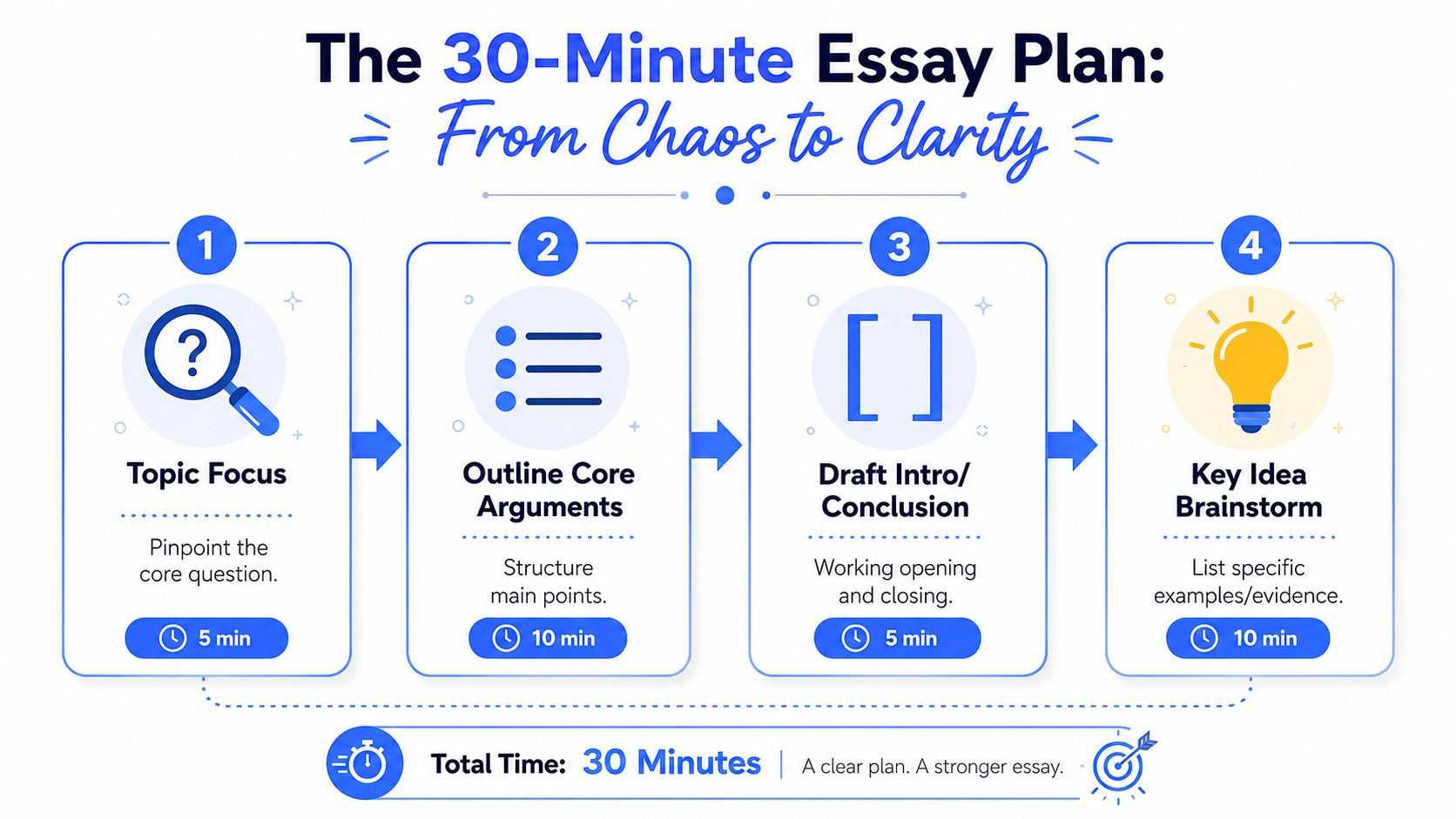
A fast planning block works best when each chunk has one job:
- Read the prompt slowly
- Mark the task words
- Turn the topic into answerable questions
- Choose a position before you start drafting
Scribbr's guidance on academic essays stresses planning the structure before drafting and carefully interpreting the question in their academic essay resources. Under deadline pressure, that saves more time than it costs because it stops you from drafting three paragraphs that do not answer the assignment.
Unpick the question first
Rushed essays often go wrong because the writer answers the topic instead of the actual question. A decent paragraph will not save a misread brief.
Strip the prompt down to three notes at the top of the page:
- The exact task
- The limits of the topic
- Your provisional answer
Be blunt with task words. “Evaluate” asks for judgment. “Compare” asks for a shared basis of comparison. “To what extent” asks for a qualified answer with room for tension or limits.
A provisional answer is enough. You are not writing the perfect thesis yet. You are choosing a direction so the draft can move.
Use question-framing to build the outline
Students under pressure often list points too early. The result is usually a pile of ideas with no sequence.
Question-framing is faster and cleaner. Instead of dumping possible points, write the questions a good essay must answer in order. That gives each paragraph a job and exposes weak logic before you waste time drafting it. A practical explanation of this approach appears in this video on question-framing.
Try something like this:
- What is the core issue?
- Why does it matter in this context?
- What is the strongest interpretation or claim?
- Which evidence supports it?
- What objection or limitation needs a response?
Those questions usually turn into your introduction, two or three body paragraphs, and a counterargument or limitation paragraph.
If you are writing an argument-heavy paper, it also helps to study a clear persuasion structure. Model Diplomat's guide on how to write persuasive essays shows how to arrange claims, counterpoints, and evidence without sounding rambling or repetitive.
Build a rough skeleton, not a pretty outline
Speed comes from reducing decisions. Once the question is clear, sketch the essay in the simplest format possible:
- Intro: answer the question and preview your line of argument
- Body 1: first reason or theme
- Body 2: second reason or theme
- Body 3: counterargument, limitation, or strongest supporting example
- Conclusion: restate the judgment and why it holds
That is enough structure for most short university essays.
If the blank page still slows you down, talk the outline out loud before you draft it. I often tell students to open their notes app, dictate the answer to the prompt in plain language, and then pull the best sentences into the plan. It is a fast way to hear whether the argument makes sense. If you want a practical setup, this guide to writing faster with voice dictation shows how to use speech-to-text without creating a messy transcript.
The goal at the end of these 30 minutes is simple. You should have a clear question, a working answer, and a paragraph order you can follow at speed.
Drafting at High Speed Speak Your Essay into Existence
Planning wins the argument. Drafting wins the clock.
The biggest mistake at this stage is trying to produce a clean version. Fast drafting works when you accept that the first pass will be uneven, repetitive, and occasionally clumsy. That isn't failure. It's throughput.
Why messy beats polished at this stage
The best rapid-drafting mindset is the messy first draft. A student describing this approach reported producing 40,000 words in one week by using timed 500-word sprints, working in 30 to 40 minute blocks per section, and refusing to edit mid-draft. The same method suggests a 500-word sprint takes about 30 minutes, lets writers cover 2 to 3 pages per hour, and makes a 10,000-word essay possible in 20 hours of focused work in this Reddit write-up on rapid essay drafting.
That doesn't mean your essay needs to be huge. It means speed improves when you stop interrupting yourself.
Use placeholders aggressively:
- [add source]
- [check citation]
- [example needed]
- [define term]
Each placeholder saves you from a derailment. You keep moving, and your future self can fix the gap later.
A quick sprint method looks like this:
- Pick one paragraph target: Don't tell yourself to “work on the essay.” Tell yourself to draft the paragraph answering one question from your outline.
- Set a timer: The timer matters because it cuts off hesitation.
- Ban editing during the sprint: If a sentence is ugly, leave it ugly.
- Stop only when the timer ends or the paragraph exists: Not when you feel uncertain.
How to dictate without losing structure
Typing is fine. Speaking is often faster, and it changes the mental feel of drafting. When people speak through an idea, they often produce a more natural line of reasoning than when they peck at a keyboard and over-monitor every clause.
That's why voice dictation is such a useful overlooked tool for essay emergencies. You can talk through your paragraph as if you're explaining it to a classmate, then clean it up later. If you want a workflow built around that, this guide on writing faster with voice dictation gives practical ways to turn spoken thinking into usable draft text.
The trick is not to “perform” your essay. Speak in structured chunks.
Try this pattern out loud:
- State the paragraph claim.
- Explain what you mean.
- Insert the evidence or example.
- Say why that evidence matters.
- Link back to the thesis.
That spoken structure maps neatly onto academic prose. It also reduces the stop-start rhythm that kills momentum.
A few dictation habits help:
- Say punctuation when needed: “Comma,” “period,” and “new paragraph” can keep the draft readable.
- Use spoken placeholders: Say “add source here” instead of opening a new tab and disappearing into research.
- Talk from notes, not from memory alone: Keep your outline visible so you don't drift.
- Accept repetition on the first pass: Spoken drafts repeat themselves. That's normal.
Here's a short demo format if you want to see a dictation-first workflow in action:
Say the idea before you try to perfect the sentence. Spoken clarity often arrives before written polish.
If dictation feels awkward at first, start with the body paragraphs. They're easier to speak than introductions because they have one clear job. Once you've spoken two or three solid body sections, the introduction usually becomes much easier to draft.
The Lightning Revision Pass Polish Without Procrastinating
Revision under pressure is triage, not renovation. If you try to perfect every sentence, you'll waste the final stretch on details that don't move the grade.
Do one macro pass
Start with the big things that make an essay feel competent.
Ask:
- Does the introduction clearly state the argument?
- Does each body paragraph do one distinct job?
- Do paragraphs follow a logical order?
- Does the conclusion conclude, rather than just stop?
Oxford's essay guidance notes that using active voice makes writing more direct and improves clarity, reducing the need for syntactic revision. It also notes that an introduction that explicitly states the argument can reduce overall revision time by up to 40% because it gives the essay a clearer structural anchor in Oxford's essay writing guidance.
That's why the introduction matters so much during a time crunch. If the intro is vague, the whole paper feels harder to fix.
Then do one micro pass
Only after structure is sound should you look at sentence-level issues.
Read the essay aloud if you can. If you don't have privacy, use text-to-speech and listen. Awkward phrasing is much easier to hear than to see. For dictated drafts, this matters even more, because speech often creates small errors that your eyes skim past. This guide on how to proofread dictated text faster on desktop is useful if your rough draft came from spoken input.
Use a quick cleanup checklist:
- Cut obvious repetition: Spoken and rushed drafts both repeat phrases.
- Fix topic sentences first: Weak openings make paragraphs feel lost.
- Check citations before commas: A missing reference hurts more than one clunky sentence.
- Scan the first and last sentence of every paragraph: That's where breakdowns are easiest to catch.
Read for logic first, then for language. Most last-minute edits fail because writers reverse that order.
One more practical shortcut. Add references as you go, not at the end. If your word processor has a citation tool, use it from the start. End-stage bibliography scrambling is one of the most avoidable ways to lose time.
Sample Schedules for Emergency Essay Writing
You look at the clock, count the hours left, and realize the essay is still mostly in your head. At that point, a schedule does more than organize the work. It cuts panic because you can see what fits and what does not.
These schedules assume you are starting under pressure and aiming for a strong, credible draft. They also assume you will use timeboxing, question-framing, and fast drafting methods such as voice dictation when it helps. Many students now use AI tools to sketch possible structures or generate prompts for brainstorming, but the time saver is not the tool by itself. The time saver is getting to a usable outline quickly, then writing from that outline instead of staring at a blank page.
If you want to turn the deadline into a spoken checklist fast, this guide on how to plan your day by voice on desktop pairs well with a compressed writing block.
| Task | 1,500-Word Essay (5-Hour Target) | 3,000-Word Essay (10-Hour Target) |
|---|---|---|
| Planning and question-framing | 30 minutes | 45 minutes |
| Fast research and note capture | 45 minutes | 1 hour 30 minutes |
| Outline and paragraph targets | 15 minutes | 30 minutes |
| Drafting sprint one | 1 hour | 2 hours |
| Drafting sprint two | 1 hour | 2 hours |
| Short break and reset | 15 minutes | 30 minutes |
| Drafting sprint three | 45 minutes | 1 hour 30 minutes |
| Revision pass | 45 minutes | 1 hour 15 minutes |
| Citations and formatting | 30 minutes | 1 hour |
The trade-offs are real.
In a 1,500-word essay, research has to stay narrow. Read for claims you can use, not for total mastery. A focused question-framing step helps here: instead of asking "What is this topic about?", ask "What is my answer to the question, and what three points prove it?" That one shift can save you an hour of wandering.
In a 3,000-word essay, the main risk is drift. Students often lose time because the middle sections expand without a clear job. Set paragraph targets before you draft. If you know paragraph 4 explains a cause, paragraph 5 handles a counterargument, and paragraph 6 applies evidence, the longer essay stays under control.
If you draft slowly by keyboard, dictate the first version of body paragraphs. Spoken drafting is often much faster than typed drafting, especially once the outline is set. Clean-up takes time later, but for emergency writing the speed gain is usually worth it.
If the schedule slips, protect planning, drafting, and revision first. Formatting is the last place to borrow time. A bibliography that looks slightly messy is easier to fix than an argument that never became clear.
One more practical point. If you keep freezing between blocks, the problem may be stress rather than technique. A quick read on how to stop overthinking can help you reset fast enough to keep moving.
Three Pitfalls That Sabotage Speed
Most deadline disasters start with habits that look responsible for ten minutes and waste an hour after that.
Perfectionism during drafting
Students lose serious time by polishing sentences before the argument exists. Clean prose does not help if paragraph three is still blank.
Draft ugly first. Then fix it.
A rough paragraph gives you something to revise, cut, or rearrange. A half hour spent perfecting an introduction usually leaves the rest of the essay underbuilt. Under pressure, the better trade-off is simple: get the claim down, get the evidence under it, and keep moving.
If you keep freezing on the same lines, the block is often stress, not skill. For students who spiral mentally before they spiral academically, The Anxiety Checklist's guide on how to stop overthinking is worth reading because the writing problem is often attached to a stress loop, not just a technique problem.
The research rabbit hole
Research starts wasting time the moment it stops serving a paragraph. Students keep reading because reading feels safer than deciding what they think.
Question-framing fixes a lot of this. Ask, “What am I arguing, and which paragraph needs proof right now?” Then read for that. Skip anything that does not help you answer the essay question or support a planned section.
Good notes are selective. Put the point in your own words, save the citation immediately, and move on. If a source does not help a paragraph you already know you need, leave it for later.
The myth that speed kills quality
Fast writing can still earn a strong grade if the draft has control. The main problem is usually friction. Too much quoting, too much wandering, or too much stopping to edit.
A quick quality check helps. Keep most of the paragraph in your own analysis and use source material to support it, not replace it. If the page is crowded with quotation and thin on explanation, the essay needs more of your thinking, not more tabs open in your browser.
The strongest fast essays stay narrow. Each paragraph makes one clear claim, brings in enough support to defend it, and explains why that support matters.
If the sprint drafting and dictation method in this guide fits how you work under pressure, Voice Control Pro is built for that workflow. You can dictate directly where your cursor is, get body paragraphs down faster than typing, and clean them up in the revision pass instead of losing momentum sentence by sentence.