
About 60% of people worldwide can use more than one language in daily life, based on a widely cited estimate that places 43% of the global population, roughly 3.3 billion people, as bilingual, with another 17% as multilingual (Kylian AI's bilingualism statistics). That figure changes the question. Bilingualism and multilingualism aren't unusual personal traits. They're ordinary features of families, schools, workplaces, and public institutions across much of the world.
Yet the familiar comparison, bilingual vs multilingual, often rests on an unstable foundation. Counting languages doesn't reveal whether someone can hold a conversation, write a legal document, understand technical speech, or switch comfortably between professional and family contexts. Researchers still lack a consistent way to define and score these categories, which makes comparisons weaker than they appear (Frontiers in Psychology review).
Table of Contents
- Introduction
- Understanding Bilingual vs Multilingual
- Linguistic and Cognitive Differences
- Language processing is distributed across skills
- Brain-age findings are suggestive, not conclusive
- Social and Educational Implications
- Formal programs and household language use serve different purposes
- Measurement and Proficiency Criteria
- Benchmark coverage comparison
- Why scores need interpretation
- Case Scenarios for Learners and Employers
- Recommendations for Educators and Employers
- A practical decision sequence
- Common Misconceptions and Expert FAQs
Introduction
The difference between bilingual and multilingual ability matters because language skills are used unevenly. Someone may speak two languages fluently but read only one. Another person may use three languages every week, with one for family, one for education, and one for work. A third may understand a heritage language well but rarely speak it.
That variation affects decisions made by learners, employers, educators, and policy makers. A school deciding whether to offer a second or third language needs more than a language count. An employer hiring for regional support needs to know which languages a candidate can use in writing, conversation, and specialized tasks. A researcher comparing language groups needs measurements that distinguish proficiency, exposure, and context.
This article treats bilingual vs multilingual as a practical classification problem, not a contest. It explains the linguistic distinction, evaluates claims about cognition, examines educational policy, compares assessment benchmarks, and applies the evidence to workplace and learning scenarios. The central conclusion is straightforward: the number of languages is a useful starting point, but proficiency profiles and real-world tasks provide better decision criteria.
Understanding Bilingual vs Multilingual
The labels bilingual and multilingual count languages, but they do not measure language ability. A bilingual person uses two languages, while a multilingual person uses three or more. Either speaker may have unequal skills in speaking, listening, reading, and writing, with different levels of frequency and confidence.
Consider the language functions involved. Someone might use English at work and Arabic at home. Another person might use Mandarin with relatives, English in education, and French in professional settings. These are different domains, the settings and purposes that shape how each language is learned and maintained.
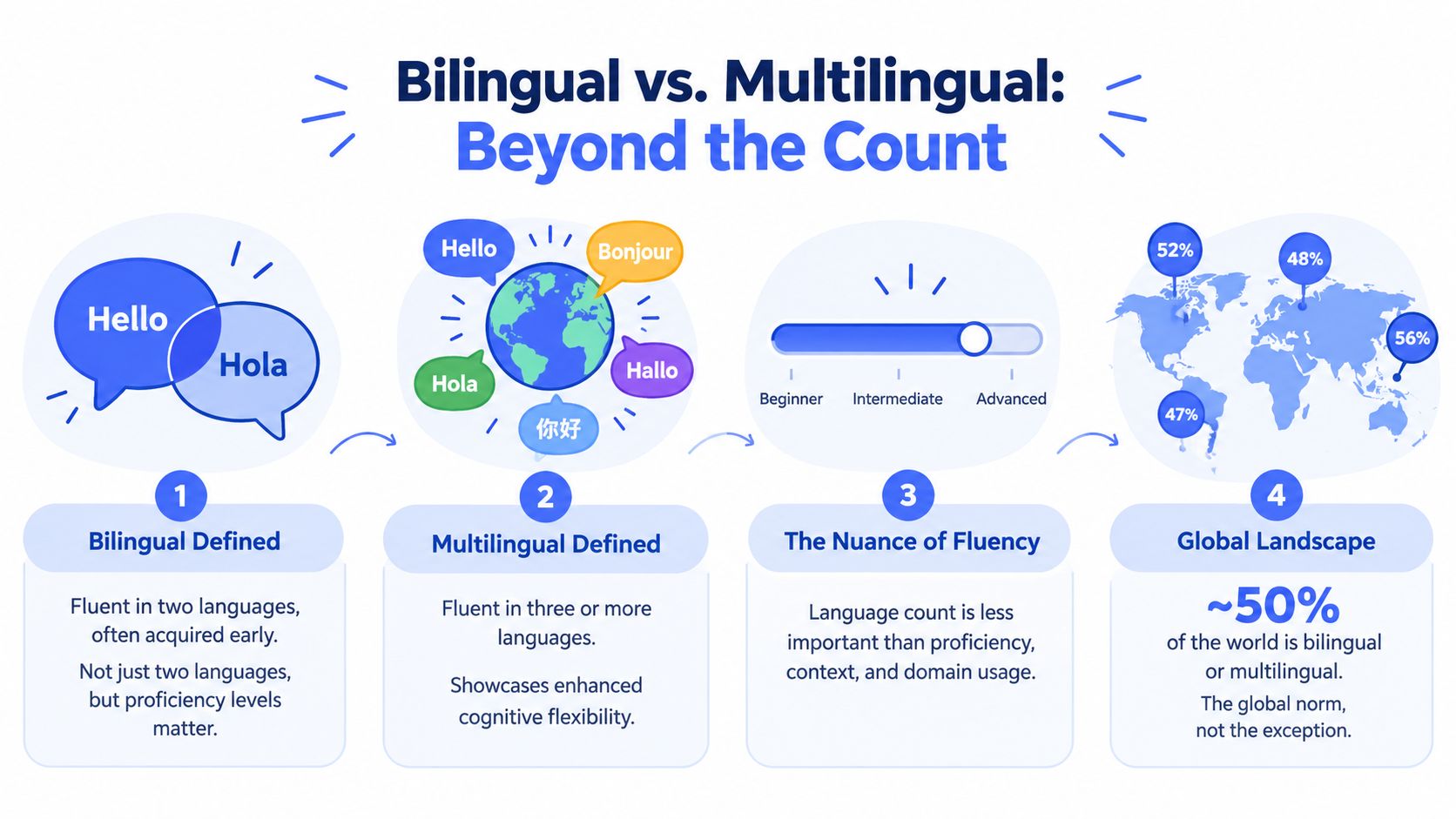
Several terms make the comparison more precise:
- Balanced proficiency describes broadly comparable ability across languages. Language labels often suggest this balance even though it is less common.
- Dominant language identifies the language a speaker uses with greater ease or across more contexts. Dominance can shift after migration, schooling, employment, or extended periods without practice.
- Domain-specific proficiency links ability to a particular task. A person may discuss family matters in one language and handle engineering, medicine, or finance in another.
- Passive ability means understanding is stronger than production. This ability can still support family communication and cultural participation.
- Literacy proficiency covers reading and writing. It often develops through explicit instruction rather than conversation alone.
Regional patterns also show why language counts require context. One estimate places bilingual population shares at 67% in Europe, 55% in Canada, 25% in India, and 20% in the United States (global bilingualism estimates). These differences relate to policy, migration, schooling, and community language practices. They do not represent a simple difference in individual talent.
Similarity between languages adds another measurement problem. Readers can learn about Irish vs Scottish Gaelic to examine how related languages may affect learning, comprehension, and the boundary between familiar vocabulary and communicative ability.
A useful profile asks four questions:
- How many languages does the person use?
- Which skills do they have in each language?
- Where and why do they use them?
- How independently can they complete the relevant task?
The final question often determines whether a language label is useful. Everyday switching may involve short exchanges, family routines, or informal interpretation. Formal education may require academic reading, structured writing, and subject-specific terminology. A person can function effectively in the first setting without meeting the demands of the second.
For learners, employers, and educators, the practical unit of comparison is therefore the task-specific proficiency profile, not the language total alone.
Linguistic and Cognitive Differences
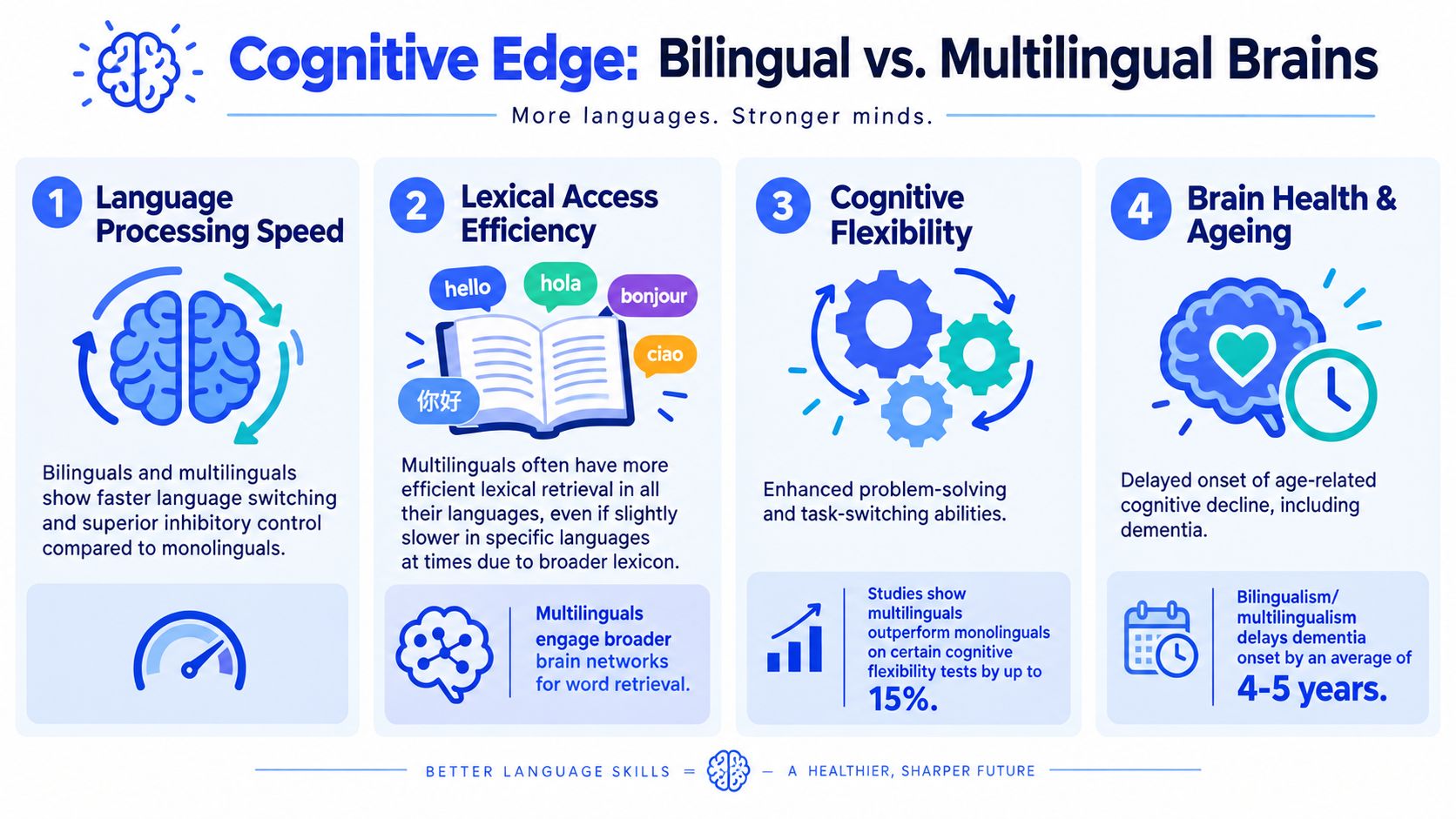
Language count alone provides a weak basis for comparing speakers. Bilingual and multilingual people coordinate overlapping systems while retrieving words, interpreting context, and selecting the language suited to a person or setting. A speaker using more than two languages may face more possible interactions among systems, but the practical effect depends on proficiency, frequency of use, task demands, and similarity between languages.
Language processing is distributed across skills
Fluency is uneven across activities. A speaker may converse easily yet struggle with formal writing, while another reads academic material confidently but hesitates in spontaneous speech. These profiles are compatible because listening, speaking, reading, and writing develop through different forms of exposure and practice.
Lexical access also involves trade-offs. A multilingual speaker has a wider overall repertoire, but the fastest word in a particular language depends on recent exposure and the immediate context. Switching can be efficient in familiar routines and effortful when a conversation requires precise technical terminology. For a practical example of adding a third language to an existing bilingual profile, see GCA's guide to German in HK.
Claims about executive control and cognitive flexibility require the same caution. Studies have reported advantages for bilingual or multilingual participants on particular tasks, while other findings vary with definitions of multilingualism, comparison groups, and outcome measures. A review reported that many studies still rely on group comparisons rather than gradient measures, and that rigorous regressions found no significant multilingual advantage when multilingualism was treated as a scalar variable (Frontiers in Psychology review). This does not establish that language experience has no cognitive effects. It shows that a simple language-count scale cannot represent that experience reliably.
Brain-age findings are suggestive, not conclusive
A study reported that multilingual participants' brains appeared younger than those of monolingual participants by about six years for bilinguals, seven years for trilinguals, and 13 years for quadrilinguals (Springer study on multilingualism and brain age). Because the evidence is cross-sectional, it compares groups at one point rather than showing that acquiring additional languages caused the observed pattern.
The groups may also differ in education, occupation, migration history, social engagement, or access to stimulating environments. A single comparison cannot separate all these influences.
Metalinguistic awareness offers a more grounded way to discuss possible differences. Managing several linguistic systems can draw attention to wording, ambiguity, register, and translation choices. Language count alone does not guarantee these abilities. Meaningful use and task demands determine whether they develop.
The defensible conclusion is conditional:
Language experience may support particular forms of attention and linguistic awareness, but “more languages” isn't a reliable substitute for measuring the person's actual experience.
Practical decisions should therefore test the relevant task. Legal interpretation requires legal reading and terminology; rapid spoken switching requires observation of live interaction. Functional evidence is more informative than a cognitive label.
Social and Educational Implications
Language choices shape identity because they connect people with family, community, history, religion, and public institutions. A household language may express intimacy and heritage, while a school or workplace language may provide access to qualifications and employment. These functions can coexist without producing equal ability across speaking, reading, writing, and formal communication.
Education policy can organize this distribution of roles. Singapore introduced its bilingual education policy in 1966, requiring English and a mother-tongue language, such as Chinese, Malay, or Tamil, in national schools (Singapore bilingual education policy timeline). The example shows that governments may treat multilingual ability as public infrastructure, not only as a result of household practice.
Formal programs and household language use serve different purposes
Schools can provide systematic literacy, standardized progression, and access to academic content. Families can provide emotional meaning, spontaneous interaction, and everyday cultural knowledge. Neither setting automatically develops every ability a learner may need.
The world's linguistic diversity makes these choices consequential for inclusion, public services, and participation. Reports describe thousands of spoken or signed languages in use worldwide. European education systems also show extensive foreign-language study, although participation in a course does not establish functional proficiency. Broad patterns therefore require cautious interpretation, especially when surveys use different definitions of “speaking” a language.
Educators should distinguish three outcomes:
- Communication: Can students understand and respond in ordinary situations?
- Academic access: Can they learn subject matter through the language?
- Participation: Can they engage with peers, family, institutions, and cultural life?
A program may succeed in one area and fall short in another. Students may speak a heritage language at home yet need explicit instruction in reading and writing. Others may complete classroom exercises successfully but lack opportunities for social use, where turn-taking, register, and cultural references matter.
These distinctions also affect assessment and support. A learner who understands classroom discussion may still struggle to produce written work, while a student with strong conversational ability may need specialized academic vocabulary. Comparing “bilingual” and “multilingual” learners without identifying the relevant setting can therefore obscure the educational problem.
Accessibility tools can reduce barriers unrelated to language knowledge. Speech-to-text resources, including this guide to speech-to-text for dyslexia, may help learners record ideas without making handwriting or typing the sole route to participation. They do not replace language instruction, but they can help educators assess linguistic ability more fairly.
The policy lesson is direct: multilingual education works best when institutions define the intended outcome, whether that is heritage maintenance, academic literacy, social integration, or professional communication. Decisions should then evaluate the language tasks that correspond to that outcome, rather than rely on language count alone.
Measurement and Proficiency Criteria
The phrase bilingual vs multilingual becomes unreliable when researchers measure people with a single label. A valid assessment should identify the language, skill, context, and task being tested. It should also distinguish recognition from production, informal fluency from academic language, and spoken ability from literacy.
Language benchmarks for artificial intelligence reveal the same issue. MKQA and LongBench both evaluate multilingual performance, but they answer different questions.
Benchmark coverage comparison
| Benchmark | Languages | Instances or tasks | Focus |
|---|---|---|---|
| MKQA | 26 typologically diverse languages | 10,000 aligned question-answer pairs, producing 260,000 language-specific instances | Open-domain question answering |
| LongBench | Chinese and English | 21 tasks across six application categories | Bilingual long-context understanding |
The figures and benchmark descriptions come from a comparative review of multilingual evaluation resources (MKQA and LongBench overview).
MKQA offers breadth. Its aligned questions make it possible to compare answers across many languages while testing open-domain knowledge. That coverage is useful when the research question concerns cross-language generalization, typological diversity, or answer consistency.
LongBench offers controlled depth across two languages. Its bilingual design and long-context tasks can expose whether a system follows instructions, retrieves information, and reasons over extended material in Chinese and English. It isn't a replacement for broad multilingual evaluation because two languages cannot represent all language families, scripts, or cultural contexts.
Why scores need interpretation
A score from a closed question-answering task doesn't equal conversational competence. A person may answer factual questions accurately while struggling with turn-taking, idioms, pronunciation, or workplace politeness. The reverse can also occur. Someone may communicate effectively in daily life without performing well on abstract written questions.
The same principle applies to organizational testing. Use a short conversation for spoken interaction, a writing sample for documentation, and a task simulation for the actual role. Record which language is used, what support is allowed, and whether the assessment measures comprehension or production.
Measure the work people need to do, not the identity label attached to their language background.
Case Scenarios for Learners and Employers
A regional customer-support team serves customers in two language communities. Managers might call the team bilingual if agents handle both markets, but that label doesn't answer the operational questions. Can agents write clearly in both languages? Can they understand informal complaints? Can they switch without losing product terminology? Can they escalate a technical issue to a colleague whose working language differs?
A practical evaluation would use chat transcripts, simulated calls, and product-specific writing tasks. The team may need strong bilingual performance rather than broad multilingual coverage if its customer base is concentrated in two languages. Adding more languages only helps when the organization can support quality, training, and escalation in each one.
Researchers face a different problem. A scientist collaborating across two languages may need high-level reading and writing in one language, plus spoken discussion in another. That profile is bilingual, but it isn't balanced. A language plan should identify which language carries papers, meetings, fieldwork, and participant communication.

Global HR teams encounter a broader coordination challenge. They may design training for employees who use a local language, a regional lingua franca, and an international corporate language. Translating slides alone won't resolve the problem if examples, assessments, manager feedback, and informal support remain available in only one language.
A useful HR profile records:
- Instruction language: Which language employees need to understand for training.
- Production language: Which language they must use in reports, presentations, or customer interactions.
- Support language: Which language supervisors and help desks can provide.
- Risk language: Which language matters for safety, compliance, or sensitive employee communication.
Speech technology can support these workflows, but the organization must test the exact use case. The discussion of why multilingual speech recognition matters on desktop is relevant where workers dictate notes, switch languages, or communicate across applications.
The conclusion from all three scenarios is counterintuitive: a narrower language program with dependable task coverage can be more useful than a broader program with untested proficiency. Employers should prioritize the languages and domains that affect outcomes, then expand only when they can evaluate and maintain them.
Recommendations for Educators and Employers
Language programs should be selected by task coverage, not by the number of languages offered. Decision-makers can begin with the population's communication demands, identify the skills attached to each demand, and then match the program to institutional capacity.
A practical decision sequence
Define the operating environment. Record the languages used by students, customers, colleagues, families, and regulators. Identify where misunderstandings occur, since the most visible language may not carry the greatest operational risk.
Specify proficiency by skill. Assess listening, speaking, reading, and writing separately. Add domain vocabulary when learners or employees must work in medicine, law, engineering, finance, or technical support.
Choose the narrowest sufficient model. A bilingual program may cover the central need when two languages serve the main educational or operational tasks. A multilingual model is justified when users regularly shift among several languages and the institution can provide instruction, assessment, and support in those languages.
Use mixed-method evaluation. Combine structured tests with interviews, writing samples, role-play, and authentic work products. These measures reveal uneven profiles that a single score can conceal, such as strong workplace speaking alongside limited formal writing.
Review performance over time. Schooling, migration, and work can change language dominance. Reassessment helps distinguish a stable skill gap from a profile in which the strongest language varies by task.
Measurement remains a practical constraint. Researchers lack one standard method for defining or scoring bilingualism and multilingualism, which weakens comparisons across studies and makes institutional labels easy to misinterpret. Schools and employers should therefore document their own criteria, intended tasks, and evidence thresholds rather than treating internal categories as universal standards.
For knowledge workers, voice input may assist multilingual drafting and accessibility. Voice Control Pro provides voice-to-text across applications, supports 99+ languages, and can transcribe in a selected language or detect the language automatically. Its local processing mode is designed for on-device dictation, while Max features add language support and tools for rewriting and contextual assistance. Evaluation should use the organization's terminology and privacy requirements. Language availability alone does not establish suitability.
A focused multilingual voice dictation desktop workflow can support rapid notes, messages, and drafts across languages. Human review remains necessary for meaning, register, and sensitive content, while formal proficiency assessment should determine whether a person can perform the wider role independently.
Common Misconceptions and Expert FAQs
Does speaking more languages always produce better cognitive outcomes? No. The evidence is mixed and context-sensitive. The brain-age finding described earlier is cross-sectional, and reviews have found that language count alone doesn't consistently predict a cognitive advantage.
Does bilingual mean equally fluent in both languages? No. Bilingual speakers often have different strengths by domain. Someone may speak one language at home and write another at work.
How many languages make someone multilingual? In ordinary usage, multilingual generally means using three or more languages. The label still needs a proficiency description because minimal familiarity and independent professional use aren't equivalent.
Should schools test every language in the same way? No. Test the intended outcome. Use oral interaction for communication, reading tasks for literacy, and subject-specific work for academic or professional ability.
Does childhood acquisition guarantee stronger results? No guarantee follows from age alone. Exposure, opportunities to use the language, schooling, social need, and the quality of instruction all shape outcomes.
Is passive understanding a valid form of bilingualism? It can be. Understanding a family or heritage language has social value even when active speaking remains limited. Institutions should describe that profile accurately rather than treating it as failure.
The most defensible answer to bilingual vs multilingual is therefore conditional: classify by language count, decide by proficiency profile, and evaluate by task.
Voice Control Pro supports multilingual work by inserting polished voice transcription directly into the active application, with language selection or automatic detection and local processing options for privacy-sensitive workflows. If you draft, research, study, or answer customers across languages, visit Voice Control Pro to assess whether its multilingual dictation and writing tools fit your daily tasks.