
You're sitting across from a family member who keeps asking, “What did you say?” The room is quiet, so you try a quick whisper in one ear, then the other. They repeat a few words and seem to pass. That result feels reassuring, but it can't answer every question about their hearing.
The whisper voice test is a useful bedside screen when it's administered carefully. It can indicate that someone may need a formal hearing assessment, but it can't identify the cause, measure hearing thresholds across pitches, or prove that hearing is normal. The biggest source of error is often not the person being tested. It's the technique.
Table of Contents
- Why the Whisper Voice Test Is Not a Guarantee
- Setting Up Your Environment for an Accurate Test
- Control the variables that change the result
- How to Administer the Whisper Voice Test Step by Step
- Understanding Accuracy and Limitations Across Populations
- Why age and hearing pattern matter
- When to Escalate Beyond Home Screening
- Treat the result as a decision point
- Comparing the Whisper Voice Test to Formal Hearing Assessments
Why the Whisper Voice Test Is Not a Guarantee
The whisper voice test measures whether a person can hear and repeat selected whispered words or numbers under particular conditions. It doesn't measure hearing in decibels, map sensitivity across frequencies, or distinguish conductive hearing loss from sensorineural hearing loss.
That distinction matters because a screening test answers a narrower question than a diagnostic assessment. Sensitivity describes how often a test identifies people who have the condition. Specificity describes how often it correctly recognizes people who don't have it. Neither measure turns a pass or fail into a diagnosis.
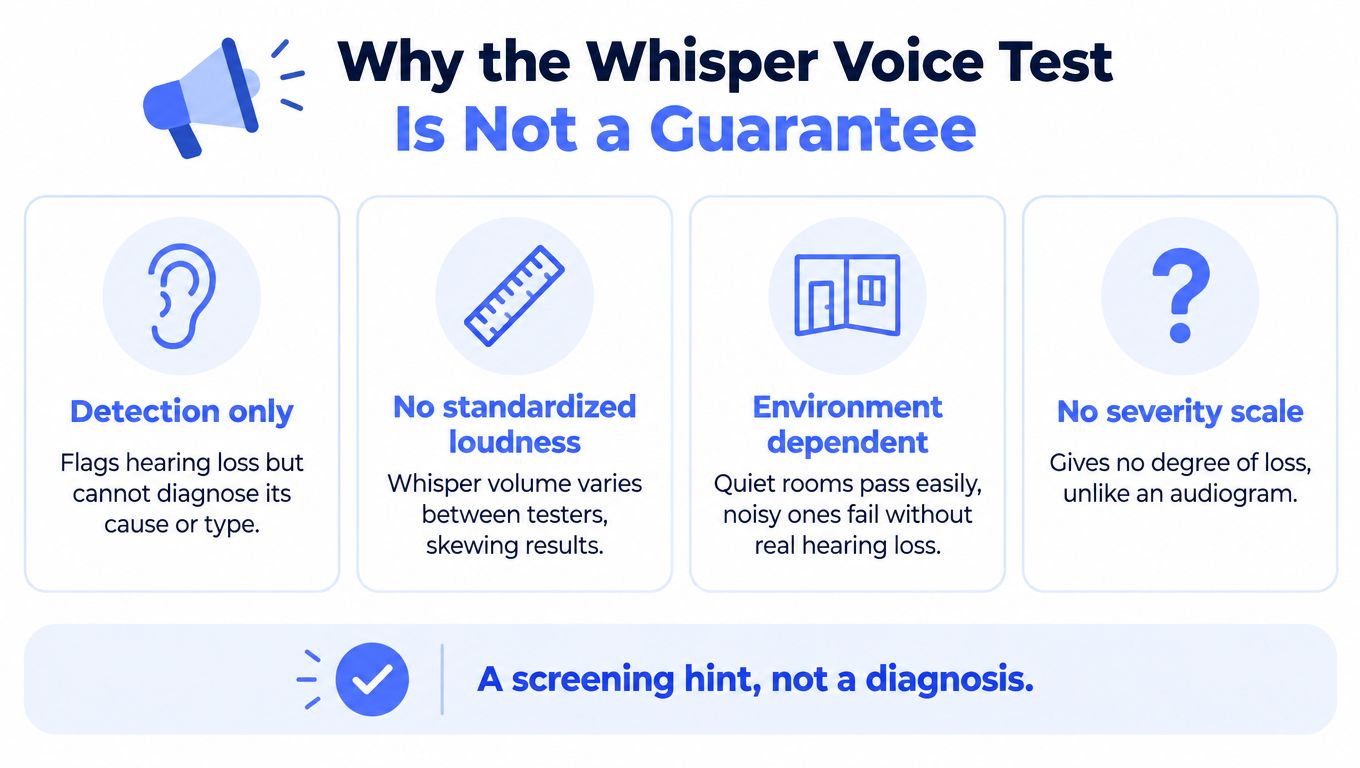
A 2003 systematic review of the whispered voice test found eight diagnostic studies, four involving adults and four involving children. The studies used six different techniques, which is the central problem: two people can both say they administered a whisper test while using meaningfully different distances, words, ear-covering methods, or whisper volumes.
Among adults, sensitivity ranged from 90% to 100%, while specificity ranged from 70% to 87%. In children, sensitivity ranged from 80% to 96%, and specificity ranged from 90% to 98%. The review described the test as simple and generally accurate, but warned that results could be less reproducible in primary-care settings.
Clinical rule: A whisper test is a screening hint, not a hearing diagnosis.
The result can shift when the examiner whispers more loudly, stands closer, chooses easier words, allows lip-reading, or tests in a room with competing sound. It can also miss problems that affect speech understanding in noise, high-frequency hearing, or one ear more than the other. Used responsibly, the test helps decide whether formal audiometry is sensible. Used as proof that hearing is fine, it creates false reassurance.
Setting Up Your Environment for an Accurate Test
A careful setup does more for reliability than rushing through a longer word list. Choose the quietest room available, turn off televisions and fans, close doors and windows, and ask everyone nearby to remain silent. Background noise can cover soft consonants and make someone fail even when the problem is the room rather than their hearing.
Seat the person upright. Stand behind them and slightly to the side, outside their visual field, so they can't read your lips or infer the answer from facial movements. Keep the testing distance consistent. Many protocols use roughly 30 centimetres to 1 metre, depending on the method, so record the distance you choose and use it for both ears.
Control the variables that change the result
Test one ear at a time. The non-test ear should be covered adequately without pressing hard against the ear canal. If the person can still hear through that ear, the result may reflect the better ear rather than the ear you intended to assess.
Keep the test materials and delivery consistent:
- Use a steady voice: Whisper at a moderate, repeatable loudness rather than fading into the person's ear or speaking almost normally.
- Prevent visual clues: The person should look straight ahead and avoid turning toward your voice.
- Clear obstructions: Remove headphones, hats, hair, or other barriers that interfere with ear coverage.
- Control movement: Don't drift closer after an incorrect answer unless your protocol specifically records that distance.
- Document conditions: Note the room, distance, ear tested, materials used, and any difficulty following instructions.
Practical guides to home tests for seniors can help families think through safe screening at home, but a whisper test still depends on disciplined administration. Even equipment used nearby for recording or dictation can introduce distracting noise, so this microphone setup guide offers useful principles for reducing acoustic interference.
The aim isn't speed. It's reproducibility. If the person fails, you should be able to tell whether the same result appears when the room, distance, ear occlusion, and whisper volume remain stable.
How to Administer the Whisper Voice Test Step by Step
Once the room is ready, explain the task without giving away the words. Tell the person that you'll whisper a series of short words or numbers and that they should repeat only what they hear. Guessing can make a marginal result look better than it is.
A practical protocol looks like this:
- Position the person and examiner. Seat the person with their back toward you. Use a consistent distance, commonly within the range used by the chosen protocol, and keep your mouth out of view.
- Select simple stimuli. Use a prepared list of short words, letters, or numbers. Avoid changing to easier items after a mistake. The point is to compare conditions, not to coach the person toward a pass.
- Prepare the whisper. Take a breath, exhale fully, and whisper at a steady moderate volume. Don't shout, exaggerate consonants, or let the sound become ordinary speech.
- Test each ear separately. Cover the opposite ear and present the same type of stimuli to the test ear. Give each item once unless your protocol says otherwise. The person should repeat the item, not merely signal that they heard a sound.
- Record the response. A commonly used screening convention treats repetition of at least three of six letters or numbers as a pass, but thresholds vary between protocols. Record the actual items repeated and missed rather than writing only “normal” or “abnormal.”
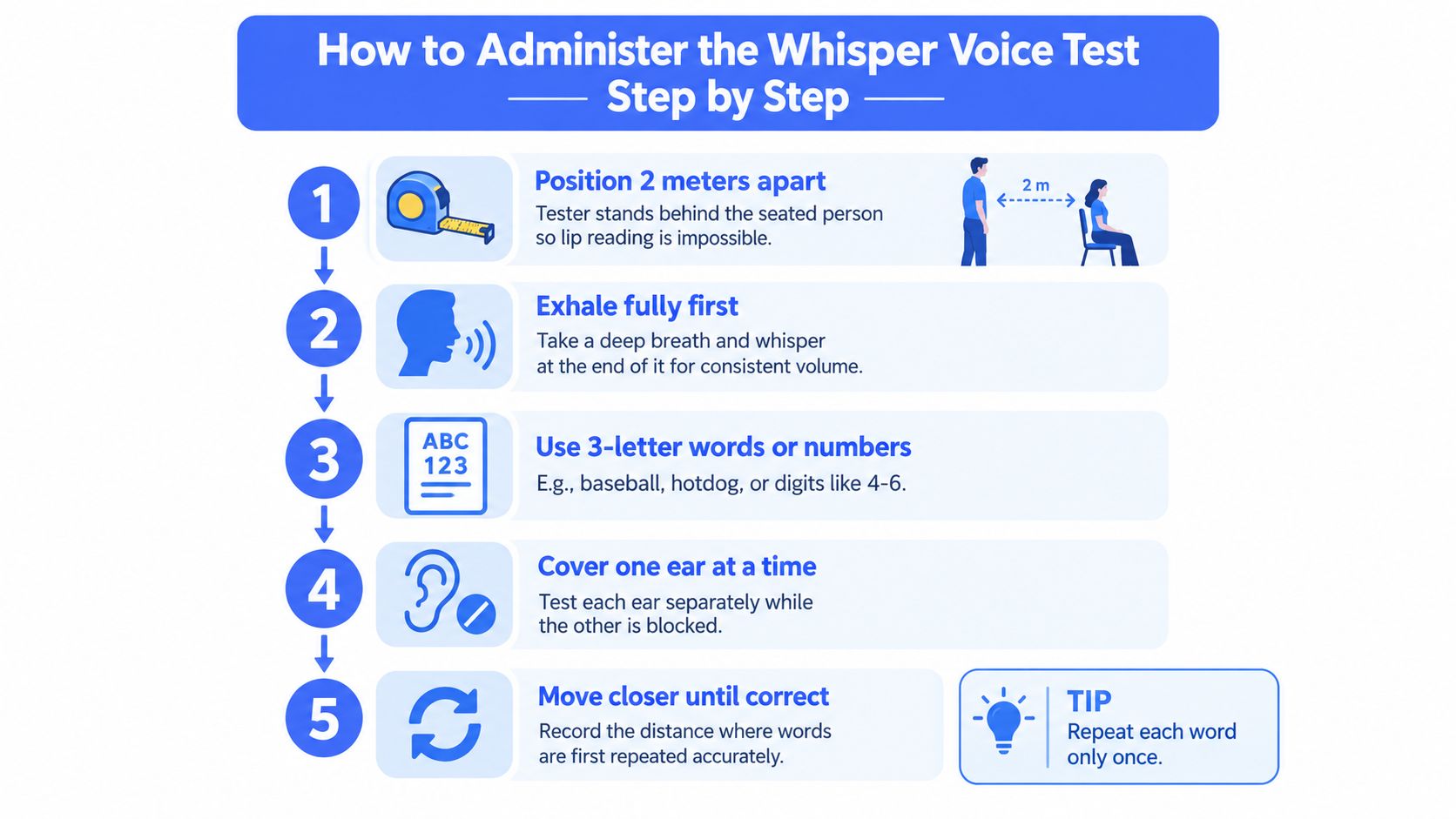
The test should feel controlled, not conversational. If the person asks for a repeat, note it rather than automatically increasing your volume. If they appear to rely on your position, clothing movement, or facial cues, stop and reset the setup.
A missed set is a screen-positive result, not proof of hearing loss. An uncertain result deserves the same cautious interpretation, particularly if one ear performs differently from the other or the person reports difficulty despite repeating enough items to pass.
Understanding Accuracy and Limitations Across Populations
The whisper voice test has its strongest established evidence as a quick screen for mild hearing loss in older adults. A U.S. Preventive Services Task Force evidence review pooled five studies involving 669 participants and found 94% sensitivity and 87% specificity for hearing loss greater than approximately 25 to 30 decibels.
That performance became less consistent for moderate hearing loss above 40 decibels. Across three studies totaling 296 participants, sensitivity ranged from 30% to 60%, while specificity remained between 80% and 98%. The practical lesson is important: a test that works reasonably well for one degree of loss may not identify another degree reliably.
A separate 2017 study of 210 adults aged 60 to 97 evaluated ten whispered words or phrases against audiometry. “Shoe” and “window” produced areas under the receiver-operating-characteristic curve of 0.918 and 0.917, while inter-examiner reproducibility values were 0.877 and 0.869. Those results support careful word selection, but they don't remove the need for confirmation.
Why age and hearing pattern matter
Children can be harder to screen consistently because they may misunderstand the task, lose attention, or respond unpredictably. The earlier review found lower sensitivity in children than in adults, even though specificity was higher. A home result should therefore be interpreted alongside observed communication, speech development, and concerns raised by caregivers or teachers.
Older adults often experience presbycusis, which commonly affects higher frequencies. A whispered phrase gives a broad speech cue, not a frequency-by-frequency profile. Someone may recognize selected words in a quiet room while struggling with consonants, group conversation, telephone speech, or speech against background noise.
Asymmetric hearing creates another trap. If the better ear contributes to the response, the test can make the poorer ear appear healthier than it is. The same caution applies to a person who passes with a familiar examiner but struggles at work or in classrooms. Screening conditions can be much easier than everyday listening conditions, much as practical speech-to-text accuracy tips focus on the difference between clean input and real-world audio.
When to Escalate Beyond Home Screening
A home whisper test is reasonable as an initial check when someone has no urgent symptoms and wants a simple indication of whether professional testing may be useful. It stops being sufficient when the result conflicts with the person's experience.
A pass doesn't cancel persistent difficulty following conversation, frequent requests for repetition, turning one ear toward speakers, or trouble understanding speech in a noisy room. Those symptoms can reflect frequency-specific, asymmetric, or speech-in-noise problems that a basic whisper screen doesn't characterize.
Treat the result as a decision point
Escalate to an audiologist or clinician when:
- The person fails or seems unsure: Arrange formal assessment rather than repeating the home test until they pass.
- Symptoms persist after a pass: Difficulty communicating remains clinically relevant even when selected whispered words were repeated.
- One ear differs from the other: Unequal results warrant attention, especially when the difference is consistent.
- Hearing changes suddenly: Sudden hearing change needs prompt medical attention rather than home monitoring.
- Other ear symptoms appear: Dizziness, ear pain, or drainage should lead to professional evaluation.
- Daily function is affected: Problems at work, in school, on calls, or in group conversations deserve a more complete assessment.
The main technical limitation is examiner variability. A government clinical guide reports sensitivity of 87% to 96% and specificity of 70% to 90%, while warning that reproducibility in primary care is uncertain because whisper loudness cannot be standardized reliably. Another clinical reference notes that experienced practitioners may whisper 8 to 10 decibels louder than inexperienced practitioners, which can materially change the result. The clinical guide on whispered voice screening explains why a pass or fail shouldn't be treated as a measured threshold.
A negative screen is reassuring only within the narrow conditions of that screen.
Professional communication also depends on knowing when a screening tool has reached its limit. Resources such as CE suicide screening training from Premiere Education illustrate a broader clinical principle: screening should support appropriate referral, not replace professional judgment. For hearing, accessible communication options and accommodations are also worth considering, as discussed in this guide to accessibility for disabled users.
Comparing the Whisper Voice Test to Formal Hearing Assessments
The whisper voice test fits at the front of the pathway. It requires no specialized equipment and can flag a possible problem in an ordinary room. Formal audiometry answers a different set of questions, including how softly a person hears sounds at different frequencies and whether the pattern suggests a particular type of hearing loss.
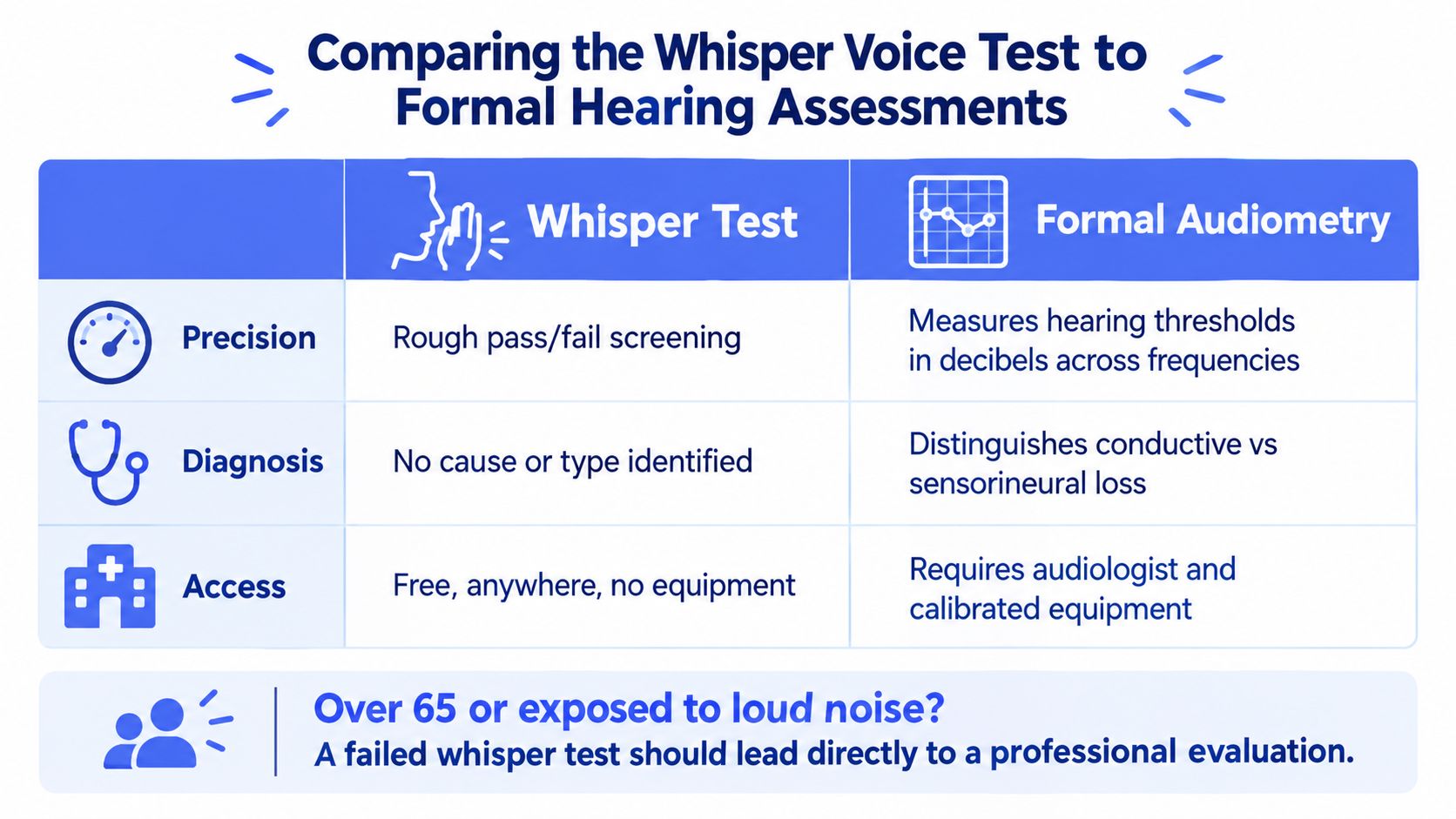
| Feature | Whisper voice test | Formal audiometry |
|---|---|---|
| What it measures | Recognition of selected whispered stimuli in a particular setting | Hearing thresholds across frequencies |
| Result | Rough screening indication | Structured hearing profile |
| Diagnosis | Doesn't identify cause or type | Helps distinguish conductive and sensorineural patterns |
| Access | Can be performed without specialized equipment | Requires trained professionals and calibrated equipment |
Passing the whisper test means the person recognized the chosen stimuli under those conditions. It doesn't establish equal hearing between ears, normal hearing at every pitch, or reliable speech understanding in noise. That limitation matters especially for older adults, people with high-frequency loss, and anyone whose main complaint appears in busy workplaces, classrooms, clinics, or telephone calls.
A failed or uncertain screen should lead to formal assessment. So should a pass that conflicts with daily communication. If you want a structured next step, you can schedule a hearing test with an audiology provider and bring the home result, the test conditions, and the symptoms you observed.
The best use of the whisper voice test is modest but valuable. Administer it consistently, record what happened, and use the result to decide whether a fuller evaluation is needed. Don't use it to dismiss a real hearing concern.
Voice Control Pro helps you capture clear dictation directly into the app you're using, which can make it easier to record symptoms, prepare questions for an audiology appointment, and draft notes without switching windows. Visit Voice Control Pro to try faster voice-to-text input with local processing options and accessibility-friendly controls.