
You can feel a thesis getting away from you before it's officially in trouble. One day you're sorting articles for the literature review, the next you're staring at a half-finished methodology chapter, three advisor comments, and a deadline that's suddenly closer than it looked in your planner. That's usually the point where thesis writing assistance stops being an abstract search term and starts feeling like a practical need.
The strongest help doesn't just “fix writing.” It gives you a way to move through the project without losing the thread, especially when the work shifts between planning, drafting, revising, and formatting. In higher education, that shift has become more pronounced as research methods and statistical analysis have grown more specialized, which is why thesis support now functions as a real market rather than a loose collection of favors and proofreading offers. The useful question is not whether you need help. It's what kind of help fits the stage you're in, the standards your examiners expect, and the tools that let you keep writing when typing is the bottleneck.
Table of Contents
- Introduction to Thesis Writing Assistance
- Plan Your Thesis Timeline and Tasks
- Build the thesis around chapter deadlines
- Protect time for advisor meetings and buffer periods
- Evaluate and Choose Assistance Options
- Compare support by task, not by label
- Vet the fit before you commit
- Leverage Productivity and Dictation Tools
- Use dictation for hard paragraphs, not every paragraph
- Create a repeatable daily capture routine
- Structure Drafting and Revision Workflows
- Draft in sections, then revise for argument
- Keep revisions traceable
- Master Citation Best Practices and Integrity
- Keep the reference trail visible as you write
- Check the content, not just the formatting
- Troubleshoot Common Problems and Conclusion
Introduction to Thesis Writing Assistance
A thesis usually fails by accumulation, not by one dramatic mistake. You miss a week on the literature review, spend too long on one analysis decision, get a vague note from your supervisor, then spend another week trying to decode what changed. The pressure isn't just the writing load, it's the number of moving parts that have to stay aligned while you keep producing pages.
That's why thesis writing assistance works best when it matches the task in front of you. In practice, support can mean topic selection, research structure, literature interpretation, charts and tables with statistics, style-guide compliance, time management, or proofreading, depending on where the project is stuck. Providers now commonly package that work as an end-to-end service, which tells you something important about the thesis process itself. It's no longer treated as a single writing event.
A better mindset is to treat the thesis like a sequence of decisions that need different kinds of help. Early on, you need structure and scope control. Later, you need drafting discipline, revision logic, and a clean citation trail. If you're using dictation tools or a voice workflow, that matters too, because a long thesis often becomes easier to finish when you can capture ideas quickly, then refine them later instead of waiting for the “perfect” typing session.
Plan Your Thesis Timeline and Tasks
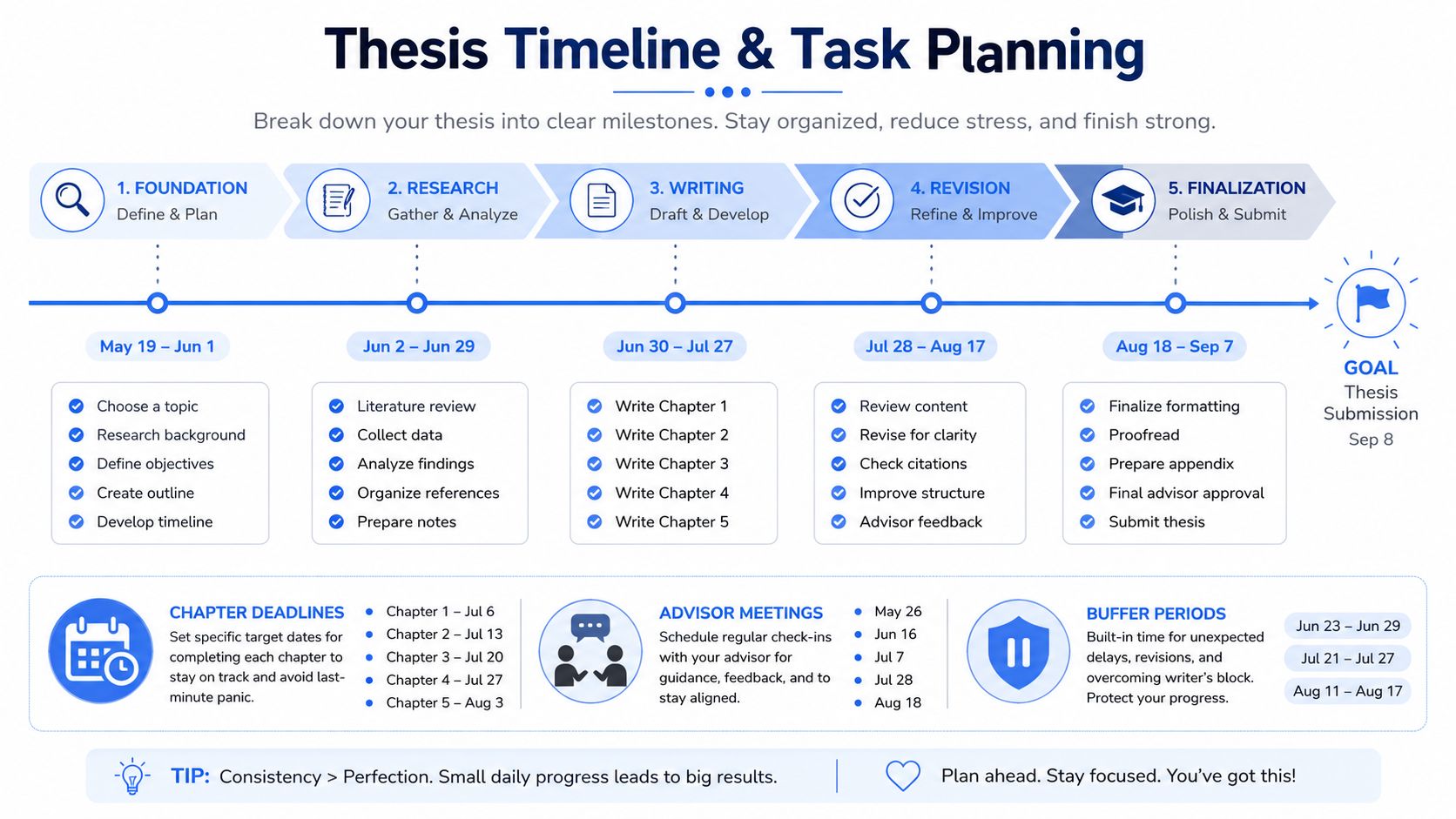
A thesis becomes more manageable the moment you stop thinking in one giant deadline and start thinking in chapter-level targets. The most reliable planning method is to reverse-engineer the final submission date into a sequence of smaller finish lines, then protect time for feedback and revision. A detailed chapter outline comes first, because long-form arguments are easier to control when each section has one purpose and each paragraph carries one idea. Expert guidance also recommends a hyperlinkable table of contents and consistent connectors so readers can follow the argument cleanly across a long document, which is especially helpful once chapters start expanding in different directions. The practical chapter-outline approach is described in recent thesis guidance.
Build the thesis around chapter deadlines
A workable timeline starts with the chapters that are hardest to fake. The methods and results sections usually expose whether the project is on track, so those should have clear target dates instead of vague “work on analysis” blocks. Then place the literature review and introduction around them, because those sections are easier to finalize once the analytical core is stable.
Practical rule: Put the chapter that depends on the most decision-making in the middle of the schedule, not the end. That gives you time to adjust the argument before the deadline turns every revision into a scramble.
Use short weekly goals instead of abstract monthly intentions. “Draft two pages of methods” is more actionable than “make progress on methods,” and it gives you a clean way to notice slippage before it becomes panic. If your workflow includes voice input, capture rough chapter notes verbally right after reading or meeting with your supervisor, then sort them into the outline while the ideas are still fresh.
Protect time for advisor meetings and buffer periods
A thesis timeline fails when it assumes every week will behave normally. Advisor meetings should sit inside the plan as fixed checkpoints, not as optional add-ons after the writing is done. Buffer periods matter just as much, because revisions always take longer than the first draft expects, and unexplained gaps tend to come from waiting for feedback, untangling a section, or recovering from a bad writing day.
The cleanest schedule has three layers. First, the chapter target. Second, the review checkpoint. Third, the recovery space around it.
- Chapter Deadlines: Set specific completion targets for each major section so progress is visible.
- Advisor Meetings: Reserve recurring check-ins for clarification, not just approval.
- Buffer Periods: Leave space for revisions, delays, and the stretches where writing stalls.
If you like a more external accountability layer, a structured coach such as Boss as a Service accountability coaching can help when the problem is follow-through rather than knowledge. That kind of support works best when your chapter deadlines already exist, because it gives the coach something concrete to hold you to.
Evaluate and Choose Assistance Options
Different forms of thesis help solve different problems, and the wrong match wastes time fast. Faculty advisors are strongest on research direction, peer reviewers are useful for readability and argument flow, professional editors help with expression and style, and writing centers usually sit somewhere between coaching and structural feedback. Since thesis support is now commonly sold as an end-to-end service, it's smart to compare what each option touches before you pay for anything. A provider that prices support per page or by project scope is signaling a more formalized market, not a casual editing favor. One service model references $12.99 per page and estimates a 50-page thesis at about $552.20 before or with a first-time discount, while another established provider sets a £500 minimum order value for thesis-statistics work and notes 7+ years of experience and PhD-level training for its statisticians. Those figures are useful benchmarks, not universal prices. The page-based model is outlined here, and the statistics-focused benchmark appears in this thesis statistics service description.
Compare support by task, not by label
A title like “editor” or “consultant” doesn't tell you much on its own. A better filter is the specific task you need handled, plus how much explanation the work will require on your side.
| Option | Cost Range | Primary Benefit | Typical Turnaround |
|---|---|---|---|
| Faculty advisor | Usually no direct fee | Research direction and approval standards | Depends on meeting cycle |
| Peer reviewer | Usually informal or free | Fresh reader perspective and clarity checks | Often fast, if the draft is short |
| Professional editor | Varies by scope and length | Sentence-level polish and style consistency | Often tied to document length |
| Writing center | Usually free at universities | Coaching on structure and argument | Depends on appointment availability |
Vet the fit before you commit
The most common failure mode is buying help that's too narrow for the actual problem. If your chapter is conceptually weak, a copyedit won't fix it. If your analysis is unclear, proofreading alone can't rescue the methods section.
Ask the provider what they won't do. A clear boundary usually tells you more than a polished sales page.
You should also ask for examples of similar work, clarification on revision policy, and a plain explanation of what the first draft will include. If the service handles statistics, ask who is doing the work and how they explain the analysis back to you. That matters because you still need to defend the decisions later.
A tool like Voice Control Pro's dictation setup guide is worth bookmarking when your own role is to keep the draft moving while someone else handles feedback or specialized support. Dictation doesn't replace judgment, but it does reduce the friction of getting ideas onto the page while the structure is still changing.
Leverage Productivity and Dictation Tools
Thesis writing slows down when your hands become the limiting factor. That's where dictation and productivity tools start paying off, especially in sections that require dense explanation, like methodology, findings interpretation, or the bridge between chapters. If you already have notes, articles, and advisor comments open, speech-to-text lets you turn rough understanding into usable prose before your focus drifts.
The most effective setup is simple. Keep one writing target open, one reference source available, and one capture method for ideas that arrive mid-sentence. For literature-heavy work, an AI agent for literature review can help you sort and summarize sources faster, but it works best when you already know what chapter question you're answering. Otherwise, you just produce more notes without a decision path.
Use dictation for hard paragraphs, not every paragraph
Dictation is most useful when the writing is conceptually dense. Methods, limitations, and chapter transitions often take longer to type than to speak, because the challenge is sequencing ideas, not finding them. Speech works well for first passes, especially when you're trying to explain what a table means or why a particular design choice makes sense.
It helps to dictate in short bursts, then clean the text immediately. That keeps the voice version from becoming a sprawling transcript that needs heavy repair later. The goal is not perfect prose on the first pass. It's momentum.
Create a repeatable daily capture routine
Your thesis routine should make it easy to start without negotiating with yourself. Open your outline, dictate the next subsection, then stop and revise the result before moving on. That sequence keeps the project from turning into a pile of half-remembered thoughts.
A simple habit stack looks like this:
- Open the chapter outline so you know the exact subsection.
- Dictate the rough draft aloud while your source notes are visible.
- Clean the transcription immediately so the next session starts from a usable draft.
- Save voice-captured ideas in one place so feedback and revisions don't scatter them.
If you're using a setup like how to set up Voice Control Pro, configure it once for the applications you already use most. The point is to reduce the number of small decisions between reading, thinking, and writing. The smoother that handoff feels, the less likely you are to lose an hour to friction.
Structure Drafting and Revision Workflows
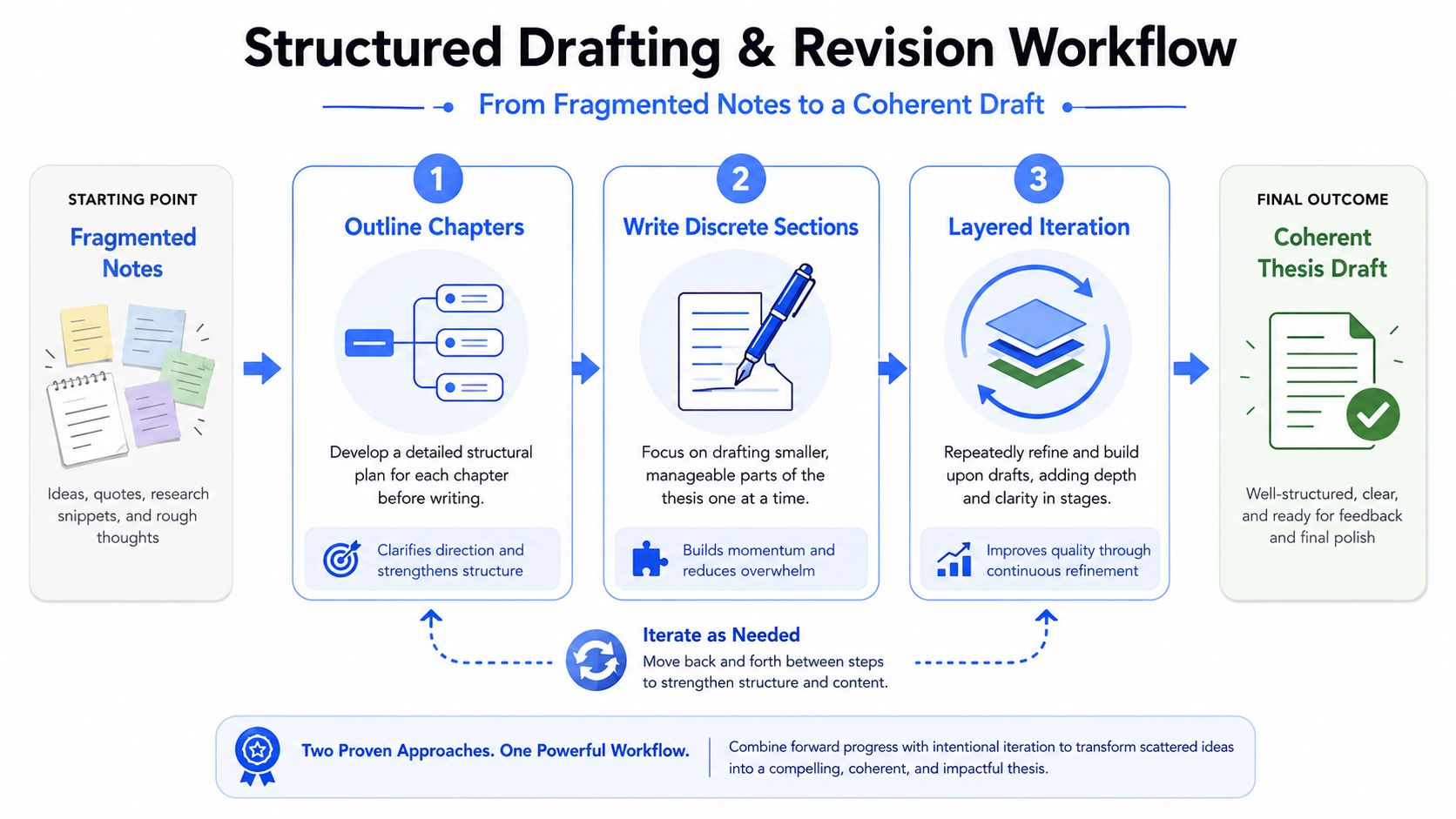
A thesis draft gets stronger when the outline and revision process work together instead of competing. If the structure is vague, feedback becomes noise. If the revision process is random, even a good outline never turns into a coherent document. The most practical model is to draft from a detailed chapter outline, write in small sections, then use repeated revision cycles to tighten the argument as the thesis evolves. Recent thesis guidance supports that outline-first approach, and university writing guidance emphasizes that a thesis usually needs repeated revision and that the thesis statement should be rewritten as the paper evolves.
Draft in sections, then revise for argument
Small sections are easier to repair than large chapters. Write one subsection with one theme, then check whether it still points back to the chapter claim. That creates a draft that can absorb feedback without collapsing.
The biggest mistake is treating the first draft as a final-form document. It isn't. It's a working structure that should be revised until the thesis still answers the prompt and makes a defensible argument. If advisor comments reveal that the chapter's focus has drifted, rewrite the thesis statement and the section transitions before polishing sentences.
Useful habit: After each feedback round, mark every comment as structural, evidentiary, or stylistic. Structural issues need reordering or reframing. Evidentiary issues need stronger support. Stylistic issues can wait until the argument holds.
Keep revisions traceable
Version confusion wastes a huge amount of time in thesis work. Save drafts with dates or clear labels, and keep a short note beside each version explaining what changed. That makes it easier to see whether feedback has been incorporated or just postponed.
For long chapters, speaking revisions can help when you need to rethink a paragraph aloud before you rewrite it. A tool like editing by voice on desktop can be especially helpful when you're comparing two versions of a passage and want to revise without getting pulled into endless manual retyping.
A thesis also benefits from reader-aware editing. Examiners need signposting, summaries, and clear links between sections so they can follow the argument, especially when the chapter sequence moves from theory to evidence to interpretation. That's not decorative writing. It's how you make the draft legible to the people who will judge it.
Master Citation Best Practices and Integrity
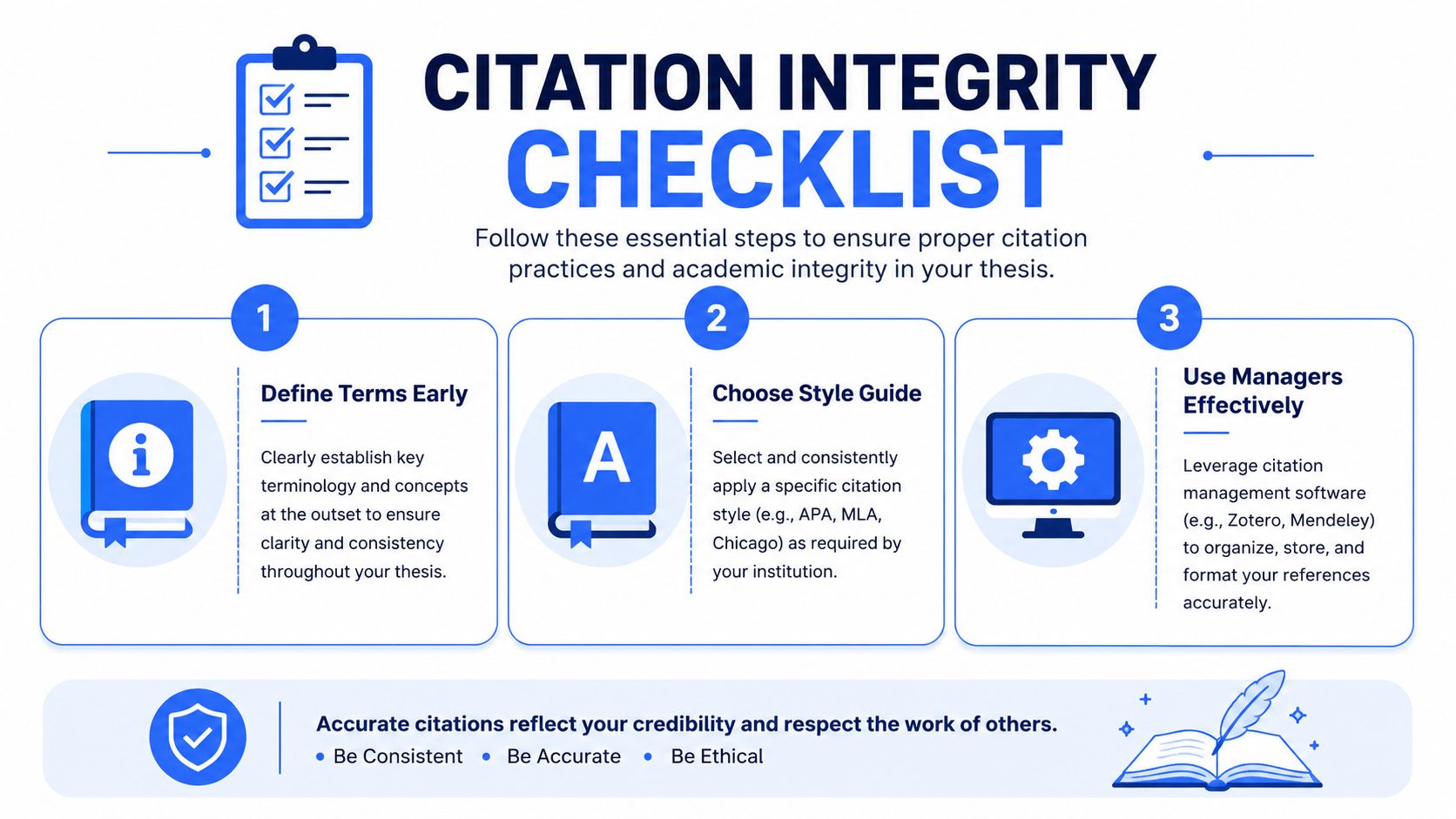
Citation integrity starts before the bibliography. If you don't define terms early, choose a style guide, and keep your references organized as you write, the end of the thesis becomes a cleanup project instead of a finishing stage. A solid system doesn't just prevent plagiarism alarms, it also keeps your argument transparent enough for examiners to follow the evidence trail.
The reader-specific side matters too. Writers need to tailor signposting, summaries, and explicit links between sections so examiners can understand how one part of the thesis leads to the next. Generic thesis advice often skips that nuance, but it's central to keeping the document credible. Research on examiner-focused writing makes that gap clear.
Keep the reference trail visible as you write
A clean citation process is mostly about habits. Don't leave references for the final week. Add them while the source is still open, and keep a running list of every work you may cite even before you know where it belongs.
- Define Terms Early: State key concepts clearly when they first appear so later citations don't carry ambiguity.
- Choose Style Guide: Pick one system and apply it consistently across in-text citations, notes, and bibliography entries.
- Use Managers Effectively: Let a citation manager organize sources, but still verify each reference before submission.
Check the content, not just the formatting
Citation tools can organize a bibliography quickly, but they can't tell you whether the citation supports the sentence you wrote. Read each cited claim in context and make sure the source backs the point you're making. That's especially important in methodology-heavy chapters, where a vague reference can hide a weak explanation.
A final integrity check should include a pass for consistency, not just completeness. If a section shifts focus during revision, the citations need to shift too. That's one reason it helps to keep sources attached to specific claims in your drafting notes, rather than storing them in a separate pile and hoping they still fit later.
Troubleshoot Common Problems and Conclusion
Most thesis problems show up after the plan is already in motion. You can have a good outline and still hit writer's block, scope creep, feedback overload, technical glitches, or burnout. The useful response is to treat each problem as a process issue, not a personal failure, because the fix usually sits in the workflow you built earlier.
Revision support is often the most overlooked part of thesis help, even though it's the part students need most once comments start coming back. University guidance emphasizes that a thesis usually needs repeated revision and that writers should keep checking whether the draft still answers the prompt and makes a defensible argument. That makes iteration the primary job, not just initial drafting. The revision-first framing is reflected in university writing guidance.
A thesis rarely breaks because the writer lacks intelligence. It usually breaks because the next action isn't clear enough.
Writer's block often means the task is too large. Shrink it to one subsection, then dictate a rough paragraph if typing feels impossible. Scope creep usually means the chapter has started answering a second question, so cut anything that doesn't support the original claim. Feedback overload tends to happen when every comment is treated as equally urgent, so separate structural comments from sentence-level edits and deal with the structure first. Technical glitches need a fallback routine, which is one reason voice input is useful when a keyboard or app starts slowing you down. Burnout needs a schedule fix, not just willpower, so the thesis timeline has to include recovery space as well as work blocks.
The clearest way to finish a thesis is to keep the system simple enough to repeat. Plan the chapters, choose help that matches the specific problem, write in sections, revise in layers, and protect the citation trail as the draft evolves. That combination turns thesis writing assistance from a vague search into a practical workflow you can sustain.
If your thesis is stuck between planning and revision, start with a cleaner drafting setup and make the next chapter easier to produce. Voice Control Pro can help you capture rough ideas, revise faster, and keep moving when typing slows you down, so visit Voice Control Pro and set up a voice workflow before your next writing session.