
You've got a deadline, a stack of notes, and a judge who won't care how hard you worked if the filing gets bounced for the wrong caption, the wrong formatting, or the wrong rule set. That's the trap in how do you write a legal brief. Good arguments lose every day because the drafter treated the brief like a generic essay instead of a court-specific persuasive document.
The fix starts before the first sentence. A brief is not just prose, it's an argument package shaped by the tribunal that will read it, and the first job is to make sure the package fits the forum. That means rules first, writing second.
Table of Contents
- What a Legal Brief Is and Why Structure Comes First
- Structure outranks style
- The brief is jurisdiction-specific
- Anatomy of a Persuasive Brief From Caption to Prayer
- Front matter earns trust
- Facts and issues have different jobs
- Argument, conclusion, and prayer do the heavy lifting
- Pre-Drafting Checklist and Outlining the Argument
- Start with court rules and the relief you want
- Turn the outline into a working draft map
- Citation Rules, Formatting Standards, and Drafting Tone
- A filing scenario that goes right, and one that doesn't
- Format choices signal whether you know the room
- Tone should sound controlled, not ornate
- Common Mistakes That Get Briefs Rejected or Weakened
- Four errors that show up again and again
- Rewrite the problem, don't just polish it
- Final Proofreading Checklist and Next Steps
- Treat the process as reusable
What a Legal Brief Is and Why Structure Comes First
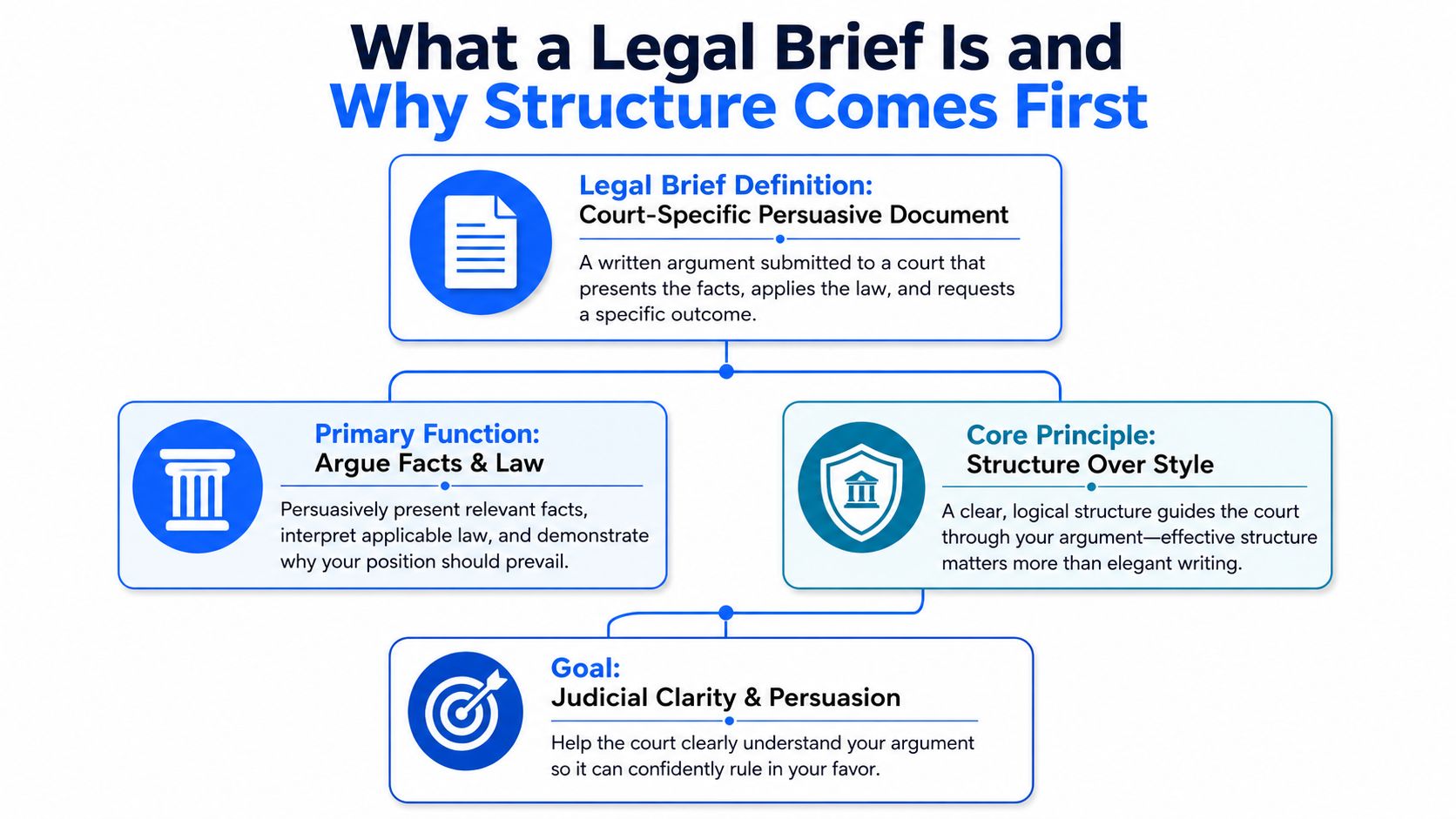
A legal brief is a structured legal argument, not a law-school essay and not a free-form memo. Westlaw's case-brief guide describes a standard set of sections, including the case name, court, and decision date, the facts, procedural history, the issue, the holding, the court's reasoning, and the final disposition. University of Houston's briefing guide adds a practical filter that matters in real drafting, the statement of facts should include the legally relevant facts and the procedurally significant facts, such as the cause of action, the relief requested, and the defenses raised. Westlaw's case-brief guide and the University of Houston briefing conventions point to the same core idea, a brief works when the reader can find the legal path quickly.
Structure outranks style
The reason structure comes first is simple. Bloomberg Law tells writers to keep briefs “short and simple,” to use crisp, direct sentences, and to avoid string cites unless they're needed to show a broad multi-jurisdictional rule. That advice reflects what judges need, a document that gets them to the controlling issue without making them dig through decorative prose. Bloomberg Law's brief-writing guidance makes the point plainly, the brief should help the reader locate the dispositive rule fast.
That's also why law-school and practice guides increasingly converge on similar templates, even when they label them differently, like IRAC or FIRAC. The method isn't the point. The point is the compressed form, a one-page-to-few-pages analytical summary that strips a judicial opinion down to the parts a lawyer needs.
Practical rule: If the court's rules and local filing conventions conflict with your preferred template, the court wins.
That's why the first move in a serious draft is to pull the applicable rules and read them cover to cover. A brilliant argument filed in the wrong format can be rejected, weakened, or made harder to use. For a useful comparison on what makes a document hold together as a legal instrument, understanding legally binding contracts is a good adjacent read, because the same discipline, form, authority, and clarity, governs both.
The brief is jurisdiction-specific
A brief is not a universal template with your preferred font on top. Bloomberg Law and Harvey.ai both emphasize court rules, precise relief, and verified authority, which is another way of saying the brief has to be calibrated to the tribunal before the argument is drafted. Harvey.ai's legal brief guide makes the procedural point that many writers skip, the most effective brief is not just well written, it's jurisdiction-calibrated.
That distinction matters in practice. Trial courts and appellate courts expect different levels of compression, and local rules often control formatting, page limits, and filing conventions. If you treat the document as a generic writing task, you end up polishing the wrong thing. If you treat it as a rule-governed filing, you get the right skeleton first and make the prose serve it.
Anatomy of a Persuasive Brief From Caption to Prayer
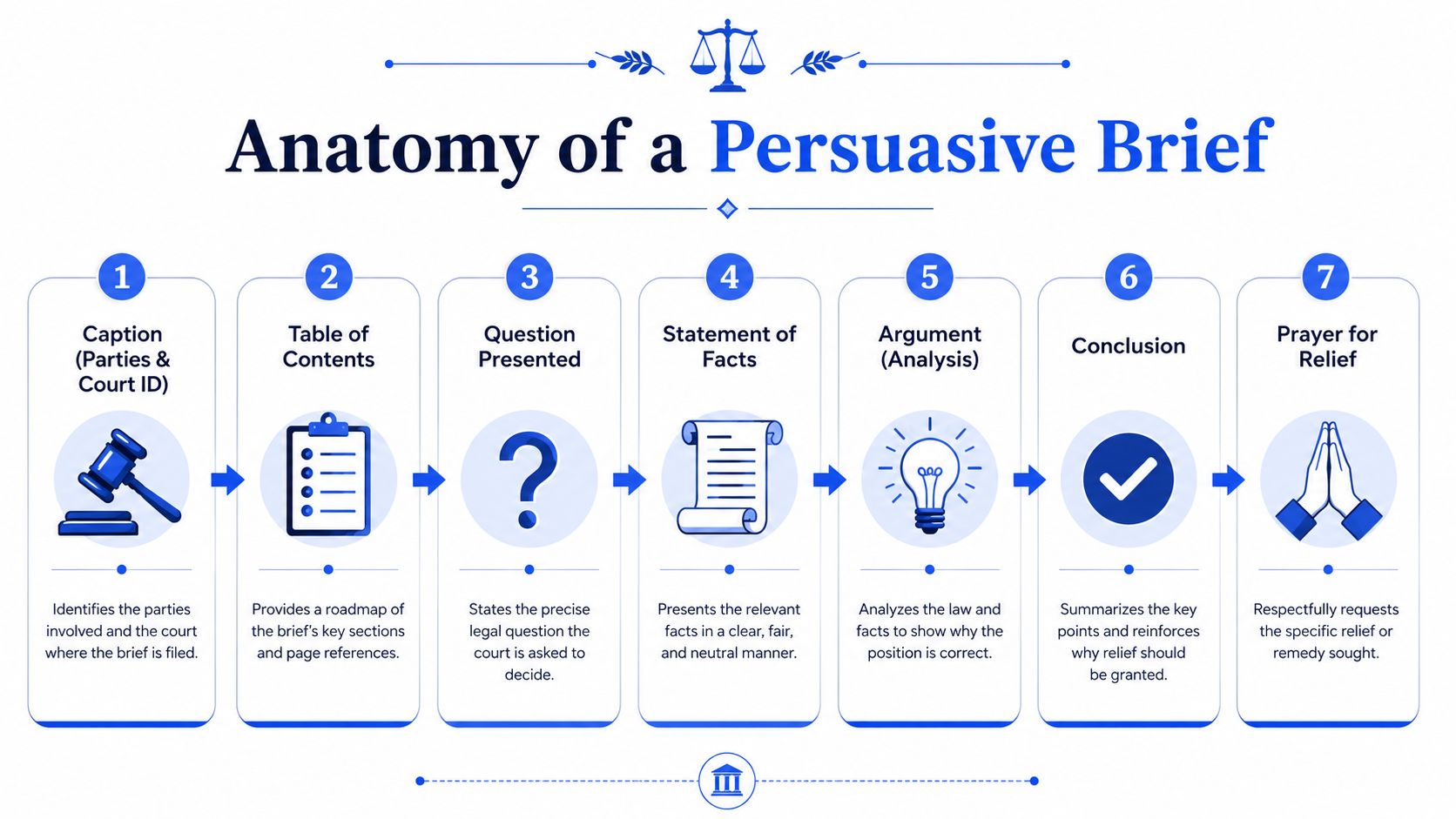
A strong brief reads like a sequence of jobs being done in order. Each section has a purpose, and if a sentence doesn't serve that purpose, it doesn't belong there. The reader, usually a judge or clerk, is looking for fast orientation first, then a clean path from facts to rule to application.
Front matter earns trust
The caption identifies the forum and the parties. That sounds basic, but it does real work, because the judge and clerk should be able to confirm instantly what court this is in, who's involved, and what kind of filing they're reading. A sloppy caption makes the whole document feel less controlled.
A table of contents helps when the filing is long enough to justify one, especially in appellate practice or a substantial motion. It gives the reader a map before the argument starts. In a brief that's being scanned under pressure, navigation matters more than ornament.
The question presented should be framed as a legal question, not as a disguised conclusion. If the issue paragraph already answers itself, the brief loses credibility before the argument begins. A clean question signals that you understand the dispute, not just the result you want.
Facts and issues have different jobs
The statement of facts should be selective. University of Houston's guidance is right to emphasize legally relevant and procedurally significant facts, because narrative color can distract from the facts that move the issue. The best fact sections read like evidence organized for legal decision-making, not like a chronology written for entertainment.
The issues presented belong to the court, not the advocate's voice. They should be contested questions, phrased so a judge can see the legal fork in the road. If the question sounds like a declaration, the section is doing too much of the argument's work too early.
Argument, conclusion, and prayer do the heavy lifting
The argument section is where rule and application meet. Think in rule, application, conclusion paragraphs, with subheadings if the issue has multiple strands. Judges want to see how authority maps onto the record, not a string of cases recited in isolation.
The conclusion should mirror the relief sought. The prayer for relief has to match what the court can order, and it should ask for the remedy with enough precision that the reader can tell what happens next if you win. That alignment sounds obvious, but mismatches happen constantly when drafters write from momentum instead of from the requested outcome.
The signature block is the final proof that the document is complete and professionally filed. It's not a decorative line at the end, it's part of the package the court receives. A brief that falls apart at the end often felt rushed long before the signature page was reached.
Pre-Drafting Checklist and Outlining the Argument
The quickest way to write yourself into a rewrite is to draft before you've built the outline. A legal brief is too procedural and too citation-heavy to improvise cleanly. The outline is the first draft, because it forces the hard decisions before prose creates false momentum.
Start with court rules and the relief you want
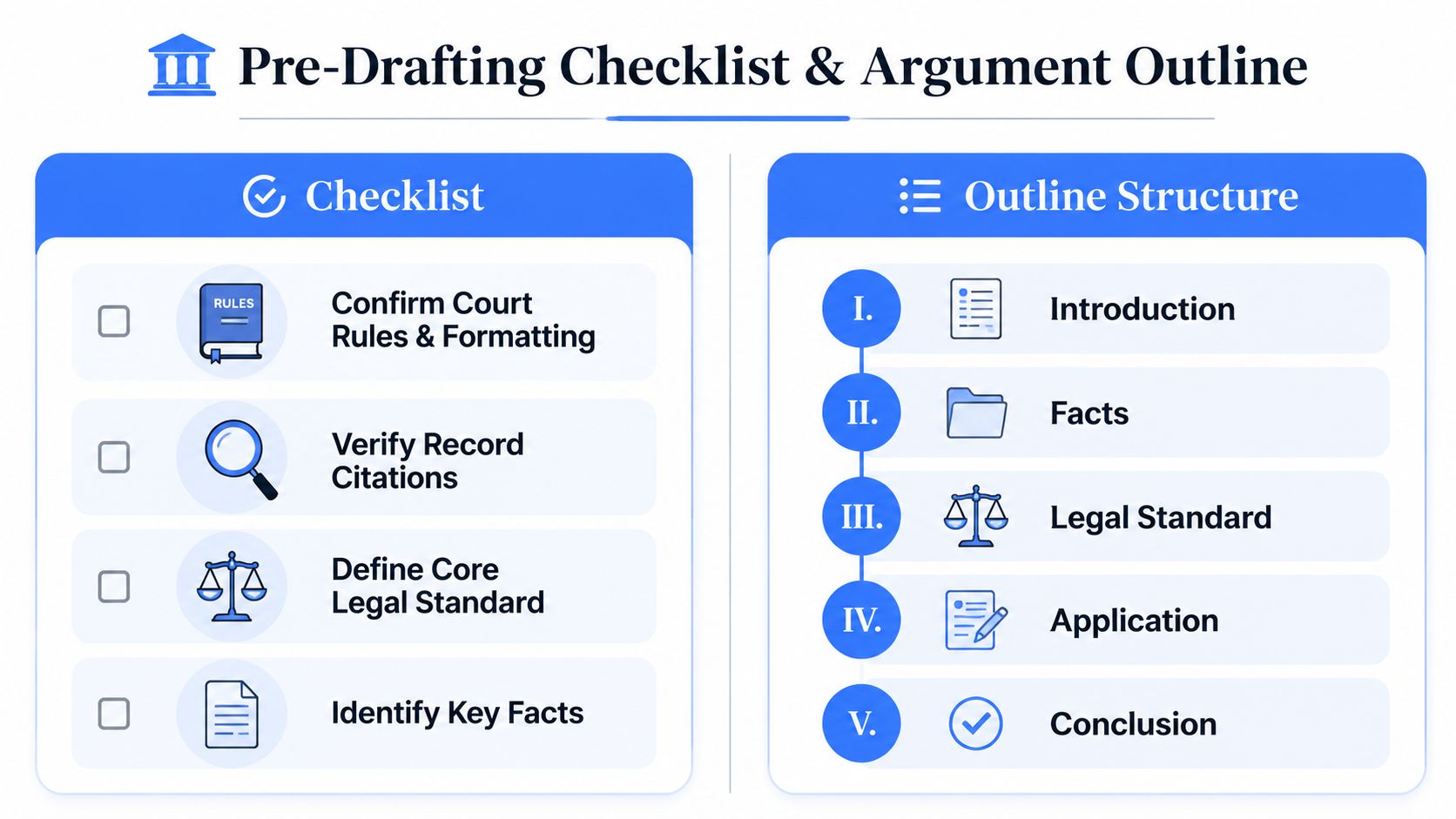
Before drafting, confirm the court rules, the local formatting requirements, the page limits, and the filing conventions that govern the case. Harvey.ai's guidance is useful here because it treats court compliance as a front-end filter, not an afterthought. If the filing doesn't fit the tribunal, the best argument in the world won't save it.
Then identify the exact relief sought. That answer drives the entire outline, because the theory of the case has to point toward a result the court can grant. If the relief is fuzzy, the draft will wander.
Next, isolate the dispositive facts and map the controlling authority. Keep the facts that matter to the rule, not every fact that appears in the record. Then stress-test the opponent's strongest response, because a brief that ignores the obvious counterargument usually sounds incomplete even when the writing is polished.
Turn the outline into a working draft map
A good outline reads like a sentence-level plan. Under each major heading, write what that section must accomplish, not just its title. For example, under argument headings, note the proposition each section will prove, the key authority, and the record facts that will carry the point.
That's where subheadings earn their keep. They break a legal theory into manageable claims and keep you from burying the court in one oversized argument block. If a subheading can't be defended with a sentence of explanation, it probably doesn't belong.
For writers who dictate first drafts, Voice Control Pro's brainstorming and outlining workflow can be useful for turning a rough issue list into a usable draft skeleton before the prose hardens. Used well, voice dictation helps you move faster through structure, not skip structure.
Drafting habit: Kill weak arguments in outline form. If a point looks thin in a bare outline, it won't become strong after three polished paragraphs.
A short practical test helps: if you can't explain why a heading exists in one sentence, the heading is doing too little or too much. That rule keeps the draft honest and prevents midstream rewrites that usually come from fuzzy theory, not bad prose.
Citation Rules, Formatting Standards, and Drafting Tone
I've seen a filing survive on the merits and still land poorly because the presentation made the clerk work too hard. A judge doesn't want to parse a brief that looks like it was assembled without a system. Citation discipline, clean formatting, and controlled tone are not cosmetic extras, they're part of the brief's credibility.
A filing scenario that goes right, and one that doesn't
Picture a motion brief with solid law but messy authority. The drafter drops in long blocks of cases, switches citation style halfway through, and uses broad statements without record cites. The argument may still be salvageable, but it now asks the reader to do extra reconstruction work. That's avoidable friction.
By contrast, a clean brief keeps the authorities tight and the prose direct. Bloomberg Law recommends only the authorities that are decisive, and that advice matters even more when the issue is narrow. In many offices, a plain-English pass also helps. HireParalegals' plain-English legal writing guidance is a useful reminder that legal writing gets stronger when the reader doesn't have to decode unnecessary jargon.
Format choices signal whether you know the room
| Decision | Common Default | When to Adjust |
|---|---|---|
| Citation form | Bluebook-compliant citation | Adjust for local court rules or court-specific citation orders |
| Page layout | Standard margins and spacing | Change only if the court's rules require it |
| Alignment | Left-aligned text | Keep left alignment when readability matters more than a perfectly even edge |
| Quotation handling | Short quotations inline | Use block quotations for longer authority that needs visual separation |
| Paragraph flow | Continuous prose | Break for subheadings when the issue has multiple legal steps |
Those choices matter because they tell the court whether the drafter knows how the forum reads. If a court's local rules call for a specific font, spacing, or page limit, follow them. If the rules are silent, favor readability over gimmicks.
I also use tools that reduce friction without changing the substance. For repetitive drafting, Voice Control Pro's punctuation dictation workflow can speed up first-pass writing while preserving control over commas, paragraph breaks, and citation placement. It's still the lawyer's job to verify every line, but dictation can help get a clean draft onto the page faster.
Tone should sound controlled, not ornate
Bloomberg Law's “short and simple” advice is the right target. Write so a federal judge or a layperson can follow the logic. That doesn't mean dumbing the brief down, it means removing verbal clutter that hides the actual theory.
Clear legal prose usually wins twice, once with the clerk who reads it first and again with the judge who needs the point fast.
Avoid the temptation to sound lawyerly for its own sake. Dense citation piles, ornate transitions, and excessive qualifiers make the brief feel less certain than the law may be. The strongest tone is usually the quietest one.
Common Mistakes That Get Briefs Rejected or Weakened
The most common brief failures aren't dramatic. They're structural and repeatable, which is good news, because they're fixable once you know what to look for. A draft usually weakens when the writer confuses description with argument or tries to save everything in the record instead of selecting what matters.
Four errors that show up again and again
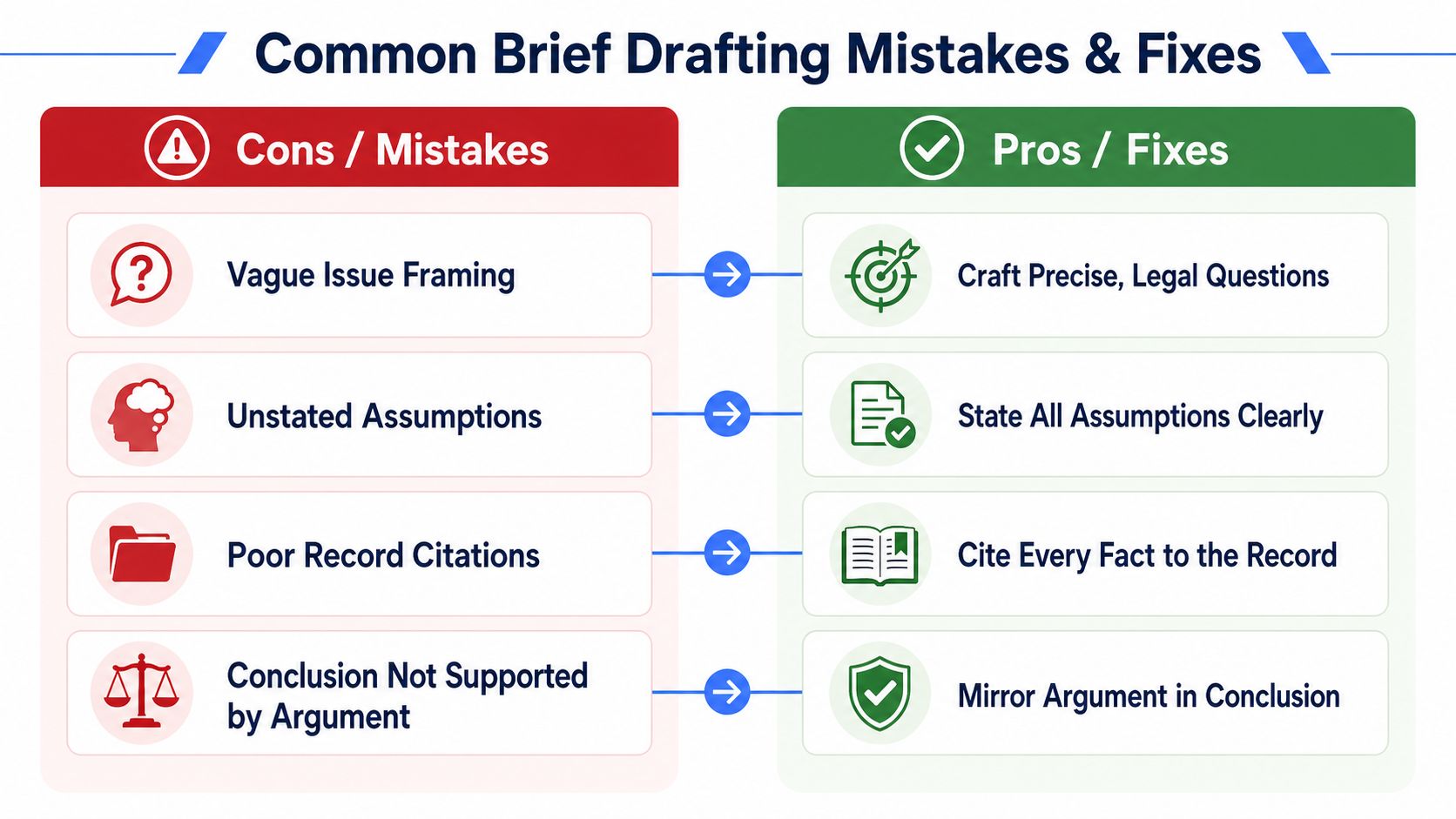
- Vague issue framing. If the question is written like a statement of law, rewrite it as a real dispute the court must answer.
- Unstated assumptions. If a paragraph depends on facts or procedural steps you never said out loud, state them plainly.
- Poor record citations. If a factual assertion can't be traced to the record, the reader loses confidence fast.
- Conclusion not supported by argument. If the conclusion goes further than the analysis, pull it back to match what you proved.
Those are not style issues. They're trust issues. Judges read carefully for internal consistency, and they can tell when a brief is trying to leap over a weak spot instead of owning it.
Rewrite the problem, don't just polish it
A bad issue sentence like “The court should dismiss because the plaintiff failed to state a claim” sounds like an answer pretending to be a question. Rewrite it into something the judge can decide. That single change often improves the whole section.
A bloated facts section does the opposite of what the writer intended. If every event in the file makes it onto the page, the legally important facts get buried under narrative weight. Trim to the facts that support the rule you're asking the court to apply.
If the argument mostly summarizes cases, you're not drafting an argument yet. You're cataloging authority. The fix is to add application after each authority, tying the rule to the record and to the relief sought.
Final Proofreading Checklist and Next Steps
A final pass should feel procedural, not creative. By then, the draft should already know what it wants to say. The job is to make sure the filing is accurate, compliant, and clean enough that the court can read it without slowing down.
A practical checklist starts with jurisdiction and filing rules. Confirm the current local rules one more time, then verify every citation, every pinpoint, and every record reference against the source materials. Sweep out string cites that do not do real work, remove conclusory sentences that restate the result without proof, and make sure the formatting matches the court's filing requirements. Judges notice when a brief is technically correct and easier to use, because that is the version they can rely on without hunting through the page.
The last read should also test readability. If a paragraph is too dense to scan once, a judge may not give it a second chance. Shorter sentence boundaries, direct verbs, and cleaner transitions help the argument land without making the brief feel thin.
Treat the process as reusable
Once the outline-to-edit loop becomes habit, brief writing gets faster because the decisions are made in the right order. The first few filings may feel slow, but the workflow tightens as soon as you stop treating every draft like a blank-page event. Voice Control Pro's faster proofing workflow for dictated text fits that process if you draft by voice and want a quick way to clean up transcribed text before filing.
The next step after proofreading depends on the case, but the habit stays the same. Build the argument for the tribunal, verify every citation, and file only after the document reads like something a judge can use immediately. If your filing also relies on signatures or client approvals, tools that streamline legal workflows with BoloSign can reduce the friction around the final handoff without changing the substance of the brief.